

Prediction market probabilities for a 2026 recession have plunged to around 28 percent. This marks a sharp reversal from peaks near 40 percent just days earlier. Traders on leading platforms now price in a significantly lower chance of economic contraction. Fresh economic data and easing geopolitical tensions drive the shift. Crowd-sourced forecasts respond instantly to new information.
Polymarket currently shows the Yes share trading near 27 cents. This roughly reflects the probability of a recession by the end of 2026. Kalshi contracts have similarly retreated, erasing much of the earlier spike. Volumes stay robust with over 1.3 million dollars wagered on the Polymarket contract alone since its September launch.
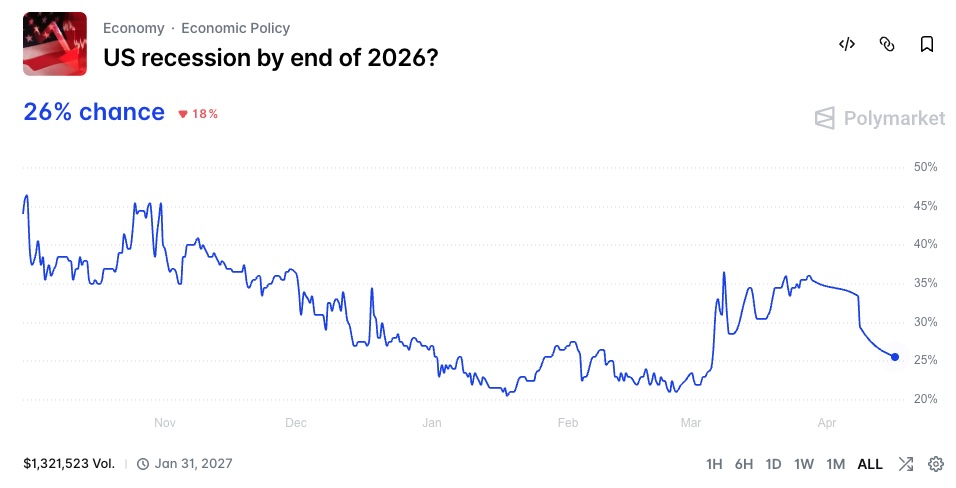
Prediction Markets Cut 2026 Recession Probability Amid Strong Economic Beats
Recent employment figures and growth trackers have fueled the decline in recession odds for 2026. March payrolls surged by 178,000 jobs and topped forecasts. This signals labor market steadiness despite prior volatility. The Atlanta Fed GDPNow model projects first-quarter expansion near 2 percent. This outpaces the subdued fourth-quarter pace adjusted for temporary disruptions.
Unemployment holds steady at 4.3 percent, while consumer spending shows underlying strength, driven by tax refunds and vehicle sales. These indicators continue beating consensus estimates. Traders now dial back fears of an imminent downturn. Inflation readings show headline pressures from energy, but core measures are moderating toward target levels.
Traders buying No shares cite this momentum as evidence that the economy absorbs shocks without tipping into contraction. The pullback in probabilities happens as markets price fewer rate cuts for the year ahead. Some contracts indicate limited easing through late 2026.
Middle East De-escalation Hopes Drive Further Drop in Recession Forecasts
Ceasefire developments in the Middle East have reduced the risk of oil supply disruptions. This contributes directly to the slashed 2026 recession odds. Brent crude prices stabilized after earlier spikes. The move eases inflationary pass-through that previously threatened consumer wallets and corporate margins. Prediction market participants now view sustained energy stability as a key factor supporting growth projections.
Active traders highlight that short-term positive news, such as ceasefires, bolsters the No side. One holder of over 10,000 No shares questions the rising odds post-announcement. Overall sentiment tilts toward resilience. This de-escalation narrative aligns with broader market pricing that assumes supply chains normalize without major drags on output.
Recent 2026 Recession Probability Trends Across Platforms
| Date | Polymarket Yes Probability | Kalshi Approximate Yes Probability | Key Trigger |
|---|---|---|---|
| Early April 2026 | 40% | 37% | Heightened conflict concerns |
| Mid-April 2026 | 30% | 28% | Initial data releases |
| April 16, 2026 | 27% | 23-28% | Strong jobs and GDP trackers |
Wall Street Diverges From Prediction Market Wisdom on 2026 Recession Risks
JPMorgan economists peg the chance of recession by the end of 2026 at 35 percent. This exceeds the latest crowd-sourced levels. Goldman Sachs aligns more closely at 30 percent, while Moody’s chief economist Mark Zandi maintains an estimate near 50 percent. Zandi points to his Vicious Cycle Index that flashed warnings earlier in the year. These institutional views contrast with the tighter range now prevailing on prediction platforms.
Prediction market participants appear more optimistic than some bank desks. They incorporate the latest data beats and geopolitical cooling faster. Large positions underscore this divergence. These include a 69,000-dollar Yes bet by trader XVFlow and a 23,700-dollar No stake by allen111 on Polymarket. Such commitments reveal conviction amid conflicting signals from traditional forecasters.
2026 Recession Forecast Comparison
| Source | Estimated Probability |
|---|---|
| Polymarket (Current) | 27% |
| Kalshi (Recent Average) | 25% |
| Goldman Sachs | 30% |
| JPMorgan | 35% |
| Moody’s (Mark Zandi) | 50% |
Trader Sentiment Shifts as 2026 Recession Odds Continue Falling
Active participants on the platforms express mixed yet increasingly bullish views on economic durability. Some warn of lingering oil-driven inflation risks that could still pressure growth into negative territory during the first half of 2026. Others emphasize rebounding job metrics and resilient private demand as reasons to favor the No outcome.
Discussions reference historical patterns where energy shocks preceded downturns. Current data suggest the economy is navigating these pressures without breaking stride. Polymarket traders holding substantial “No” positions point to ceasefire momentum as validation of their stance. This evolving dialogue keeps volumes elevated and probabilities fluid.
This video features Bankrate analyst Stephen Kates reviewing probability shifts tied to recent data and external events. It offers context on market reactions.
Broader Implications of Lower 2026 Recession Probabilities
Reduced odds influence expectations around monetary policy. Contracts show slim chances of aggressive rate easing this year. Traders now anticipate the Federal Reserve will maintain a cautious path as inflation gradually moderates. Stock indexes hover near records partly because lower recession fears support risk appetite and corporate earnings outlooks.
Consumer and business investment appear poised to benefit from this sentiment. This assumes energy prices do not reaccelerate. The contraction in probabilities also tempers concerns over corporate leverage and household debt levels that some commentators flag as vulnerabilities. Markets price in continued expansionary conditions through the balance of 2026.
Prediction platforms capture these nuances through continuous trading. Participants adjust positions as payroll reports and inflation prints emerge. The current pricing suggests collective confidence that recent beats represent sustainable momentum rather than fleeting noise.
Morgan Stanley strategist Ellen Zentner shares perspectives on consumer resilience and recession risks. Her comments complement the latest platform movements.
Resolution Criteria Anchor the Precision of 2026 Recession Bets
Contracts resolve based on Bureau of Economic Analysis data confirming two consecutive negative GDP quarters. They also resolve on a formal National Bureau of Economic Research announcement within the defined window. This structure ensures that outcomes are tied directly to official metrics rather than to subjective interpretations. Traders monitor upcoming advance estimates closely for potential volatility.
With the market extending into late 2026, participants are weighing quarterly releases and revisions that could further swing probabilities. Current pricing reflects the balance of resilient indicators against lingering external risks. The sharp decline demonstrates how swiftly these platforms incorporate evolving realities.
Overall, the drop to 28 percent odds injects fresh optimism into economic discourse. It reminds participants that forecasts evolve with each data point. Traders continue positioning as the year unfolds. They keep the conversation alive on whether this resilience persists.
Why the 2026 Recession Probability Drop Matters for Investors
Lower probabilities encourage allocation strategies favoring equities and growth assets over defensive plays. Corporate leaders gain breathing room to pursue investments in technology and infrastructure without immediate contraction overhang. Policymakers monitor these signals when calibrating fiscal and monetary responses to sustain momentum.
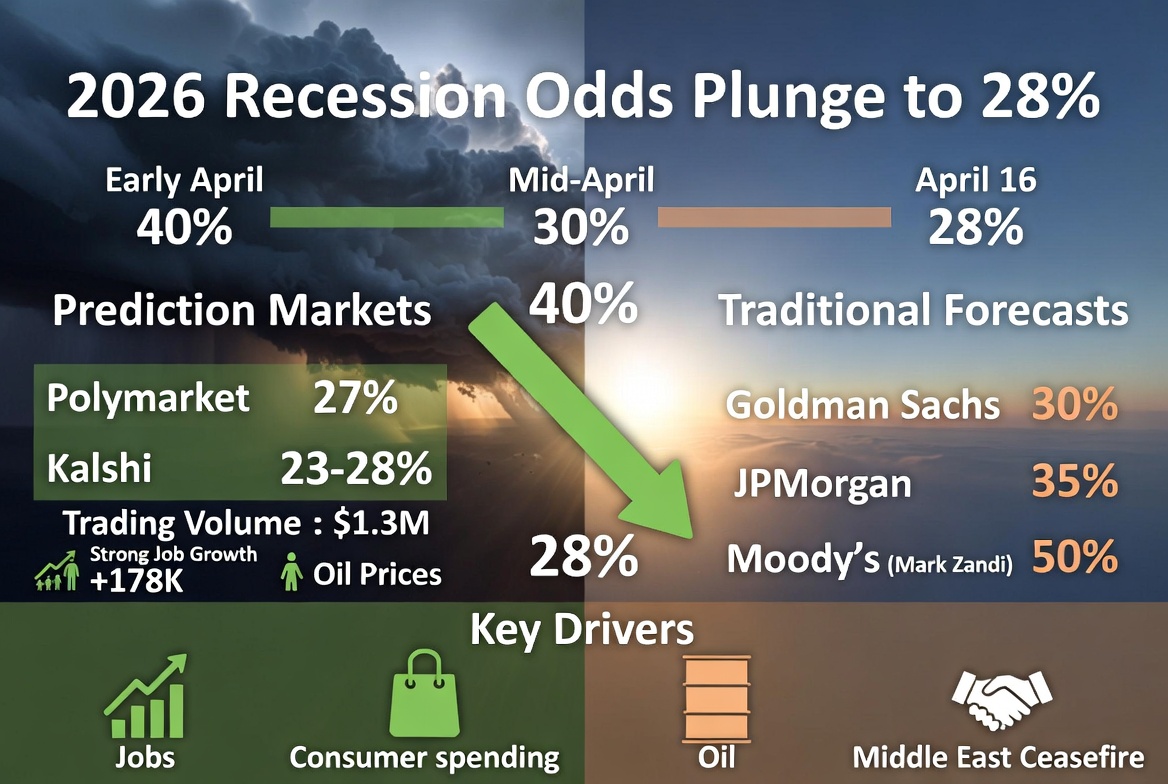
The movement also validates the speed at which prediction markets process information compared to slower-moving institutional models. Participants adjusting to the new lower range anticipate further data support or potential reversals if headwinds intensify. This real-time pulse keeps the 2026 outlook fluid and engaging for all involved.
As probabilities stabilize near current levels, attention turns to the next releases that could test or reinforce the downward trend. The passionate engagement from traders underscores the stakes attached to these forecasts, shaping portfolio and policy decisions alike.
References
- US recession by the end of 2026? Predictions & Odds | Polymarket
- US Recession Prediction 2026: Polymarket Odds Hit 30% – Forbes
- U.S. recession odds fade as economic data keep beating – Seeking Alpha
- Polymarket X Post on 2026 Recession Probability Soaring to 40%
- Kalshi Now Places the Odds of a Recession in 2026 at 28% – Yahoo Finance
- Recession this year? Odds & Predictions 2026 | Kalshi
- The Economic Outlook and Monetary Policy – April 1, 2026 | St. Louis Fed
- US – Recession by end of 2026 (Polymarket Betting Odds) | MacroMicro
- Recession Predictions & Real-Time Odds | Polymarket
- The Employment Situation – March 2026 | BLS
- GDPNow – Federal Reserve Bank of Atlanta
- Goldman Sachs raises recession odds to 30% – Fortune
- Moody’s delivers blunt verdict on recession – The Street
- Gross Domestic Product | Bureau of Economic Analysis