
When you think about wagering on the weather, it’s easy to come away thinking this is just another random event bet for bored gamblers. But weather isn’t random; it’s merely imprecise to predict, like the outcome of a sporting event. And the reasons for placing trades on weather outcomes run far deeper than pure speculative wagering; they will increasingly serve as hedges for investors or business interests against economic outcomes driven by climatological conditions.
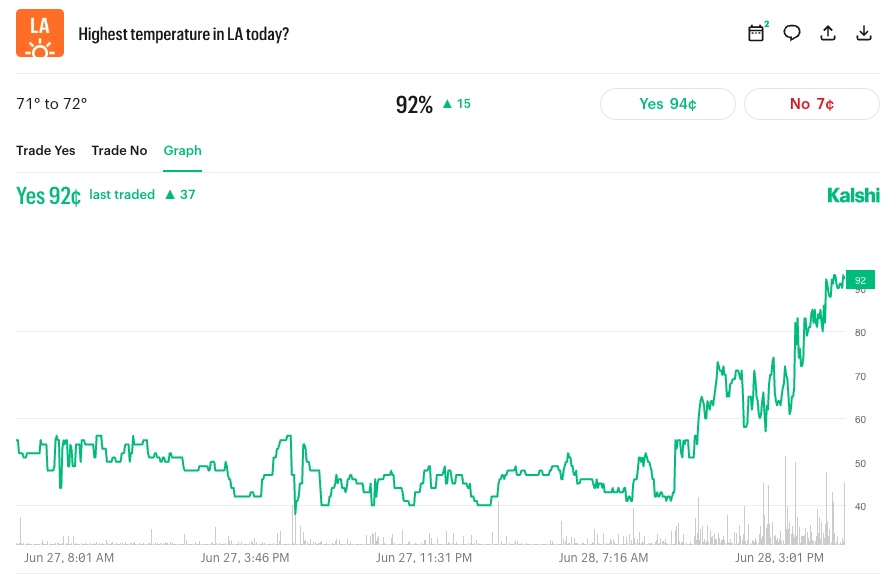
Traders across prediction markets are actively adjusting positions in daily temperature markets, while the meteorological models they choose to track update throughout the trading day. These event contracts capture precise outcomes for the highest temperature recorded on a given date, drawing consistent volume as weather patterns change. One prominent contract focused on the temperature in the city of Los Angeles for June 28 quickly surpassed $200,000 in trading volume by midday June 28.
Forecasts pointed toward a high near 73°F to 75°F, yet market pricing reflected a strong lean toward the 72-73°F range at approximately 64%. The 70-71°F outcome held secondary support near 36%. This is not guessing; it is trading on probabilities derived from data-driven predictive models.
Spotlight on High-Volume Daily Temperature Contracts
Traders bought and sold shares across narrow temperature bands from the moment the June 28 contract launched, with liquidity concentrating in the most probable ranges. This engagement mirrors patterns in similar contracts for other recent dates. Market makers and individual traders monitor official forecasts closely, adjusting bids as marine layers or onshore flows influence expected warming.
Consequently, odds swing several percentage points within hours when new model runs arrive. The structure rewards precise positioning based on detailed forecast elements such as cloud-cover timing and wind direction.
How Official Data Sources Determine Outcomes
Resolution relies on verified readings from designated airport weather stations. For the June 28 example, “the highest temperature recorded in Los Angeles Airport, CA for June 28, 2026, as reported by the National Weather Service’s Climatological Report (Daily)”.
Traders study National Weather Service climatological reports when evaluating positions, adding transparency once the day concludes. Similar contracts for other cities follow comparable protocols. This consistency lets traders apply familiar analytical approaches while accounting for regional data insight and historical accuracy charting.
Throughout each active period, meteorological updates prompt immediate position adjustments. Traders review ensemble models, satellite imagery, and surface observations while scanning order books. This dynamic environment rewards continuous attention, with price discovery happening rapidly when new information emerges. Bathroom breaks could kill you.
Some traders employ systematic strategies incorporating historical resolution data alongside current model outputs to identify edges when consensus forecasts diverge from market-implied probabilities. This is truly a market area built for algorithmic model trading and even for AI bots conducting trades without concern for those bathroom breaks.
Expanding Series of Weather-Related Event Contracts
Beyond single-day highs, broader weather-signal contracts now span multiple cities and periods. Activity often rises with weather variability, encouraging granular analysis of short-term forecasts. Real-time data feeds keep positions responsive right up to close, sustaining engagement and innovation across the series.
As previously mentioned, beyond retail traders, more and more companies directly affected by the weather are hedging their business outcomes with weather-related prediction market contracts. Examples include hospitality or venue-based businesses that can be damaged by weather-related events, or property owners who use weather contracts as a form of cash-flow insurance against weather-driven damage.
Additionally, institutional investors can hedge against larger-scale economic impacts of natural disasters such as hurricanes, tornadoes, and floods by taking positions in contracts. Insurance providers themselves can reduce financial and liquidity risk by investing in contract positions that pay out in the event of these disasters.
So while betting on moderate daily temperatures in Los Angeles has less such hedging and risk upside, it’s a taste of a growing trend that will eventually serve larger business and financial interests.
References
1. Polymarket – Highest temperature in Los Angeles on June 28?
2. Polymarket Weather Predictions page
3. Kalshi Climate and Weather Markets
4. FOX Weather – Los Angeles cools off as Western heat wave comes to an end
5. National Weather Service Climatological Report (example for LAX area)
6. WSJ – Did a Mystery Trader Tamper With the Temperature to Win Big on Polymarket?
7. Polymarket Daily Temperature Predictions
8. Kalshi Weather Forecast Markets hub
9. Outcome Edge – Kalshi Weather Betting Strategy analytics