
Insider trading and the use of undisclosed information represent a clear and present danger to the continued adoption and growth of prediction markets. Suspicions of unfair advantages for certain traders can be the undoing of the reputation required to maintain broad use.
Kalshi has launched a new policy requiring traders to disclose their employers before accessing certain high-risk contracts. The requirement, which took effect immediately after an independent audit committee’s recommendations were adopted, targets markets vulnerable to material non-public information. As trading volume continues to grow across an ever broader range of events, the move underscores Kalshi’s commitment to protecting market integrity.
Traders on corporate performance and geopolitical contracts that receive elevated risk scores now face increased personal disclosure steps. Although some users have expressed concern over added administrative friction, most seem to view the change as vital for long-term credibility amid growing scrutiny and a rising number of insider trading cases.
Kalshi’s New Risk Scoring System Flags Insider-Prone Markets
The platform’s comprehensive risk-scoring system evaluates proposed markets across six key categories before listing. Factors include exposure to corporate performance numbers, outcome concentration, and national security implications. High-scoring markets now require mandatory employment verification prior to trading.
This system enables Kalshi to screen presumptive insiders before trades execute. Head of Kalshi Enforcement Robert DeNault stated that the measures strengthen prevention and surveillance without unnecessarily burdening routine activity.
Breakdown of Kalshi’s Market Risk Scoring Categories
| Category | Description | Impact on Disclosure Requirement |
|---|---|---|
| Corporate KPI or Events Risk | Markets tied to earnings, product releases, or internal metrics | High scores trigger employment checks |
| Outcome Concentration Risk | Events dependent on few decision-makers | Elevates screening for potential insiders |
| Market Importance | Scale from niche to geopolitical significance | Critical markets face stricter verification |
| Regulatory Risk | Compatibility with CFTC rules | Influences overall approval and monitoring |
| Non-Traditional Insider Risk | Access to MNPI without formal duty | Directly activates disclosure for traders |
| National Security Risk | Links to policy or leadership events | Requires enhanced verification protocols |
Implementing this detailed scoring required substantial technical investment. This was no minor implementation. Kalshi clearly sees insider trading as a serious threat to its business success.
How Employment Disclosure Works on High-Risk Contracts
Traders in flagged markets will be asked to submit basic employment details via a simple online form. Kalshi primarily uses this information during investigations rather than for routine checks. The policy expands on already existing national security disclosures to now cover corporate and policy-driven events.
Kalshi maintains that the process stays quick and minimally invasive for compliant users. By catching connections to non-public information early, the platform prevents problematic trades. However, as anyone who knows anything about online culture knows, there will be general disdain for blockades that require information to move past, even if those requests make sense. See every age-gate ever online.
Enforcement Actions Highlight Need for Stronger Controls
In Q1 2026, Kalshi opened more than 150 insider trading investigations, blocked over 100 potential insider trades, and referred more than 20 cases to law enforcement. These figures reveal the platform’s aggressive stance against misconduct, though they are all nominal and provide no reference to the relative numbers of insider traders flagged or caught. This is 150 caught out of how many? 200 or 20,000? Either way, Kalshi is looking to add more layers of protection.
Key Statistics from Kalshi’s Q1 2026 Enforcement
| Metric | Figure | Context |
|---|---|---|
| Investigations Opened | 150+ | Confidential until resolved |
| Potential Insider Trades Blocked | 100+ | Via new screening tools |
| Referrals to Law Enforcement | 20+ | Includes high-profile cases |
| Disciplinary Actions | 5 | Formal platform sanctions |
Rising volumes have basically amplified incentives for misuse. Fraudsters go where the money is. Nobody risks federal indictment for a tiny haul. These markets are larger and growing; hence, motivation increases.
Whistleblower Tools Boost Community Vigilance
Kalshi also added easy reporting features to every market page. Traders can now flag unusual activity directly to the 24/7 surveillance team. When combined with public order books, these tools turn active users into important allies in maintaining fair play.
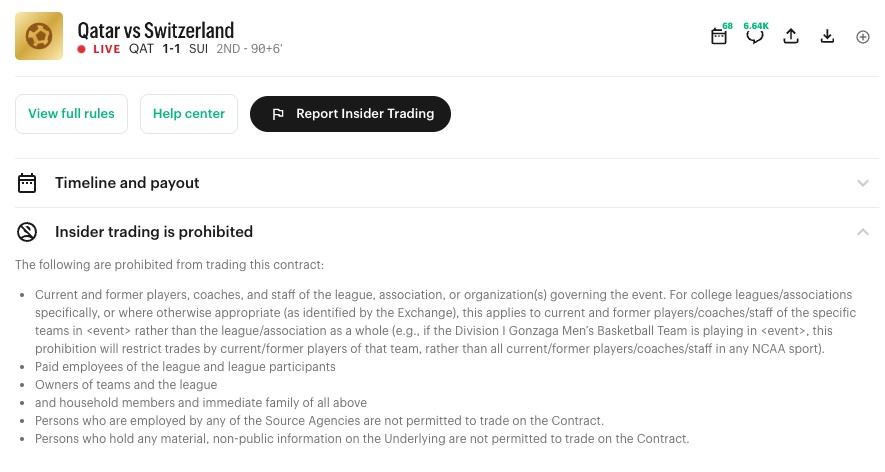
Algorithms can capture broad patterns, while traders’ reports may highlight more nuanced behaviors they observe in their markets. This hybrid approach is one Kalshi clearly hopes will help to mitigate insider trading activity.
Broader Industry Response and Future Outlook
Competitors and regulators are watching Kalshi’s implementation closely. Some expect similar standards to spread across the industry as Kalshi invests resources to be the first mover on many of these security enhancements. Kalshi has made innovation and market integrity among its chief brand trademarks.
References
- Kalshi Official Blog – Market Integrity Updates
- Wall Street Journal – Kalshi Plans Workplace Disclosure Rule
- New York Times Coverage of Kalshi Policy
- NBC News Report on Employer Disclosures
- Yahoo Finance Analysis
- BeInCrypto on Kalshi Rule Changes
- USA Today on New Kalshi Rule
- Crypto Briefing Summary
- Quartz Article on Risk Scoring
- Kalshi Insider Trading Prohibitions

The PolyPunter staff works tirelessly to bring you the latest and most insightful news, information, and tips on the fast-growing economic, financial, and social phenomenon that is prediction markets.