Traders continue flooding prediction markets with hundreds of millions of dollars on contracts forecasting the next presidential nominees and eventual winner. Volumes have exploded past one billion dollars across major platforms, including Polymarket.
Participants are betting aggressively on frontrunners such as JD Vance and Gavin Newsom while positioning early in key gubernatorial contests. This surge demonstrates a passionate embrace of political wagering, influencing campaign strategies and public perception. Analysts highlight how these markets now drive narratives far more dynamically than traditional polling methods.
Who Will Win the 2028 Presidential Election? Prediction Markets Reveal Surprising Frontrunners
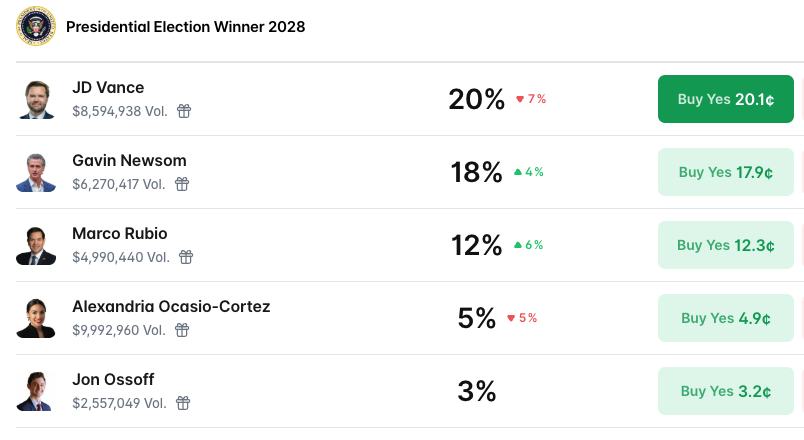
Current data from Polymarket’s Presidential Election Winner 2028 market places JD Vance at 20.1 percent probability with over $439 million in trading volume. Gavin Newsom follows closely at 17.8 percent while Marco Rubio holds 12.2 percent in the same high-liquidity contract. Bettors are reacting instantly to policy announcements and global developments, driving these shifts. The massive volumes reflect deep confidence among participants in the markets’ ability to forecast long-term outcomes accurately.
Republican nominee markets generate even fiercer competition and trading activity. JD Vance leads with 36.9 percent odds on Polymarket’s Republican Presidential Nominee 2028 contract, totaling $460 million in volume. Marco Rubio surges behind him at 27.5 percent probability. Traders adjust positions rapidly as new endorsements and events unfold. High liquidity ensures that prices effectively capture real-time sentiment. This environment excites participants who thrive on strategic forecasting.
Democratic nominee contracts show parallel intensity and engagement. Gavin Newsom dominates at 25 percent probability on Polymarket’s Democratic Presidential Nominee 2028 with nearly $888 million in total volume. Alexandria Ocasio-Cortez trails at 8.4 percent amid rising interest. These probabilities climb steadily as the field evolves. Bettors remain active, placing informed wagers on future leadership.
2028 Presidential Election Winner Probabilities and Volumes (Polymarket Snapshot)
| Candidate | Probability | Trading Volume |
|---|---|---|
| JD Vance | 20.1% | $439 million+ |
| Gavin Newsom | 17.8% | $439 million+ (shared) |
| Marco Rubio | 12.2% | $439 million+ (shared) |
| Alexandria Ocasio-Cortez | 4.8% | $439 million+ (shared) |
Democratic and Republican Fields Heat Up With Intense Wagering Strategies
Traders dissect endorsements, polling trends, and news cycles while executing multi-contract strategies. Gavin Newsom strengthens his position through steady gains in Democratic markets. JD Vance holds firm on the Republican side despite volatility from external factors. Marco Rubio capitalizes on recent momentum, boosting his share prices. Participants employing layered positions across related markets heighten the overall thrill and sophistication.
Party-level contracts introduce additional strategic depth to the wagering ecosystem. Democrats maintain a 56 percent edge in overall party winner markets on Polymarket. Republicans show resilience, particularly in candidate-specific projections. Weekly volumes frequently surpass one million dollars in these arenas. Bettors integrate diverse data sources, continually refining their approaches. The resulting dynamics captivate those passionate about electoral forecasting.
Dark horse bets sustain excitement even as frontrunners dominate liquidity. Occasional spikes occur on rumor-fueled trades for lesser-known figures. JD Vance and Gavin Newsom, however, absorb the majority of the daily volume. This pattern indicates smart money gravitating toward high-conviction outcomes.
Gubernatorial Race Markets Capture Intense Trader Interest Amid National Political Trends
The California gubernatorial contest stands out for over $7 million in combined trading volume across leading platforms. Eric Swalwell leads decisively with probabilities ranging from 61 to 67 percent on Polymarket and Kalshi. Matt Mahan, Tom Steyer, and Steve Hilton follow at single-digit levels. These market odds diverge sharply from traditional polls, which show a much closer field. Traders price in factors like endorsements more rapidly than surveys capture them.
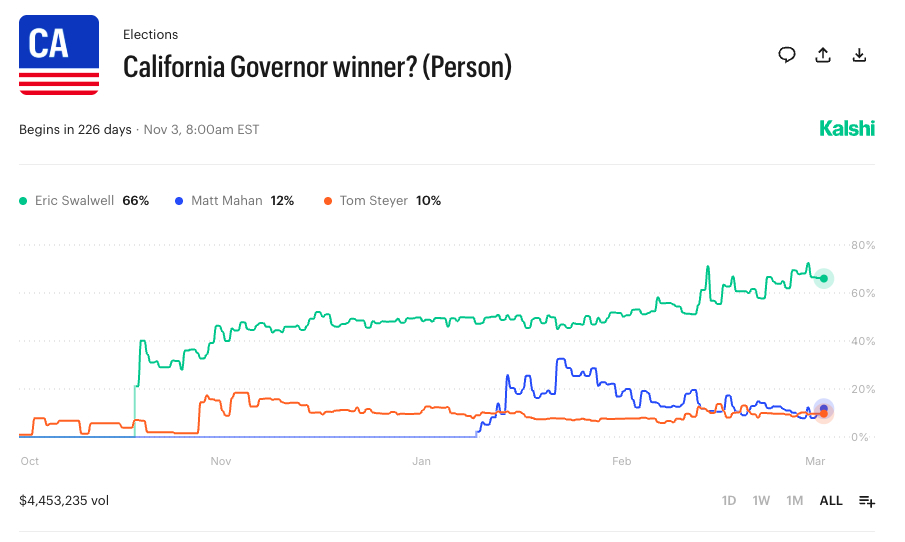
Candidates leverage strong market positions to fuel campaign momentum. Eric Swalwell frequently highlights his top ranking in public statements and on social media, including posts on his X account touting his lead. This tactic sets him apart from rivals who question the validity of the X platform.
Experts explain the divergence between markets and polls through insightful lenses. Economics professor Koleman Strumpf emphasizes that real-money risk sharpens trader predictions. Political data specialist Paul Mitchell points to endorsements such as Swalwell’s SEIU support that markets incorporate swiftly. Sacramento State professor Kim Nalder observes voters using frontrunner signals to avoid splitting support in top-two systems. These analyses fuel passionate debate about the markets’ predictive accuracy and influence.
Gubernatorial Race Leading Contender Probabilities (Aggregated Platforms)
| Candidate | Probability | Platform Volume |
|---|---|---|
| Eric Swalwell | 61-67% | $7 million+ combined |
| Matt Mahan | 8-10% | $7 million+ combined |
| Tom Steyer | 10% | $7 million+ combined |
| Steve Hilton | 8% | $7 million+ combined |
The table reflects aggregated data from Mercury News reporting and platform snapshots. Volumes have built rapidly reflecting intense interest. Participants respond quickly to news like endorsements and debates. The contest remains fluid and highly engaging for national audiences.
These markets now shape campaign tactics in meaningful ways. Candidates cite their standings to project inevitability. Donors evaluate probabilities before allocating resources. Voters encounter the figures through media and candidate communications. The feedback loop accelerates developments and keeps the political landscape dynamic.
Regulatory conversations intensify around the growing wagering volumes. Legal scholars like I. Nelson Rose question the need for oversight. Platform leaders argue the format aligns with legitimate event trading. Bettors persist at record levels, undeterred by debates. The enthusiasm surrounding these forecasts shows remarkable staying power.
Participants trading across presidential and gubernatorial markets experience genuine real-time influence. JD Vance and Gavin Newsom drive consistent spikes in volume through their frontrunner status. Eric Swalwell’s commanding lead in state wagering adds compelling narrative layers. Traders hone strategies while monitoring evolving probabilities. This vibrant space rewards keen analysis and agile decision-making.
Market movements increasingly guide campaign messaging and resource decisions. Candidates reference improving odds to build credibility. Supporters mobilize around strengthening positions. Critics raise valid concerns about possible distortions. The activity, nevertheless, highlights widespread enthusiasm for political predictive wagering.
References
- Presidential Election Winner 2028 – Polymarket
- Democratic Presidential Nominee 2028 – Polymarket
- Republican Presidential Nominee 2028 – Polymarket
- California Governor Election Winner – Polymarket
- California Governor Winner Market – Kalshi
- Prediction markets are seeing a political boom – Mercury News
- Why the betting markets may have a unique impact on the governor’s race – SF Chronicle
- Who Will Be The Democratic Nominee in 2028? Market Prediction Explained – YouTube
- Newsom SURGES — Huge Lead in NEW 2028 POLL – YouTube
- Rep. Eric Swalwell on X