
Published: November 18, 2026
Kalshi wants traders to know it’s watching, and now it’s saying where it’s watching most closely. The exchange said Tuesday that it has accepted the third-quarter report from its independent Market Integrity Committee and will start assigning risk ratings to its market. Hence, the contracts most exposed to leaks get the heaviest surveillance.
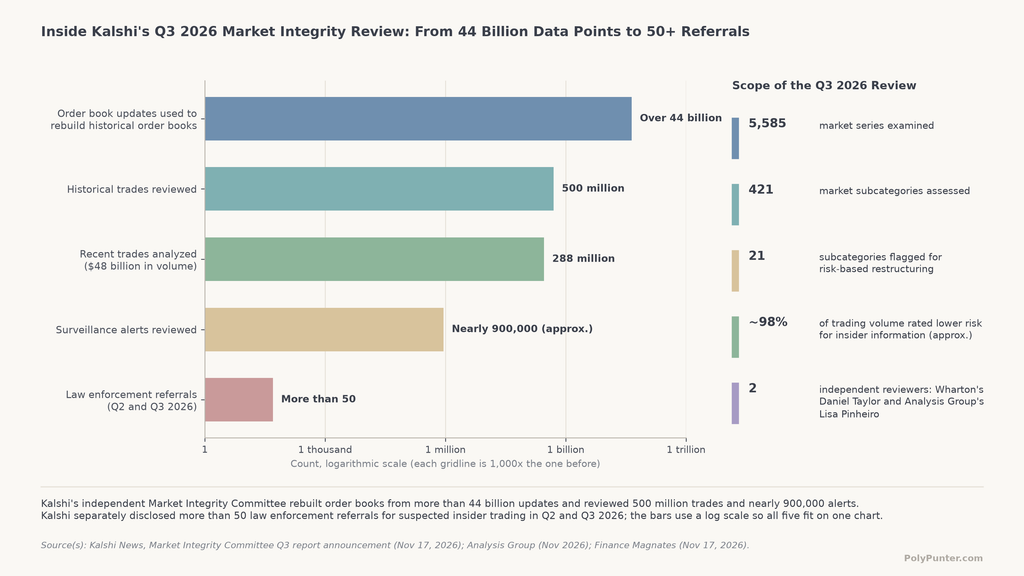
The committee’s research was enormous. Kalshi says the reviewers sifted half a billion past trades and close to 900,000 alerts its systems had already raised, reconstructing old order books from over 44 billion updates. Meanwhile, the exchange disclosed that it sent more than 50 suspected insider trading cases to law enforcement during the second and third quarters.
Still, it was a messy week to be talking about integrity. After a year of several high-media-attention insider trading stories, on the very Tuesday Kalshi launched its Martha Stewart ad, it also had to confirm that the CFTC had frozen its Trump mention markets.
What Did the Kalshi Market Integrity Committee Find?
Two people sit on the panel: Analysis Group’s Lisa Pinheiro and Daniel Taylor, who heads Wharton’s Forensic Analytics Lab. Their role is advisory: they probe Kalshi’s detection methods and suggest fixes, but the exchange’s own staff still run investigations and file referrals.
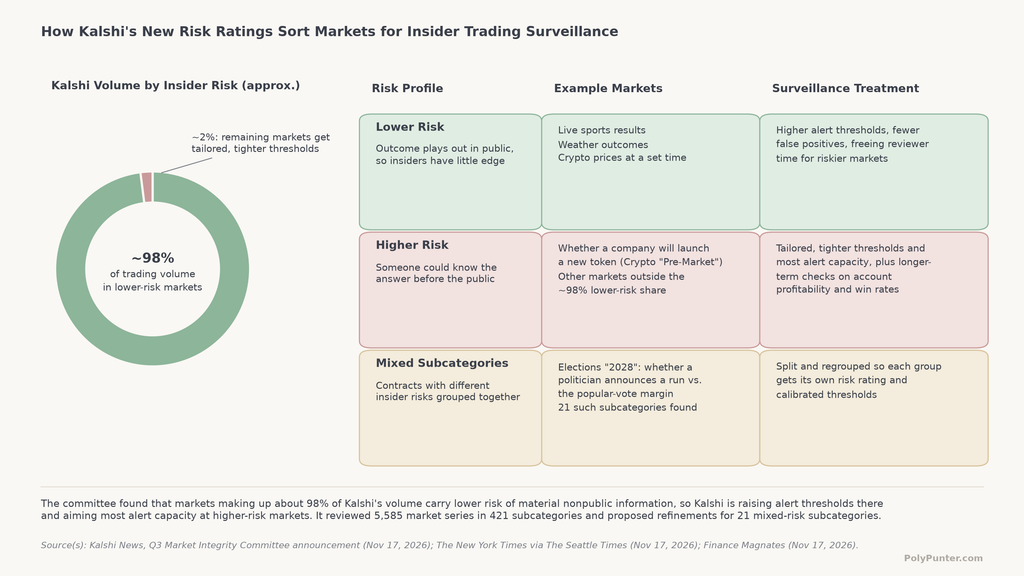
Here’s the surprise: most of Kalshi’s volume isn’t where the danger lives. The committee found that markets making up roughly 98% of trading volume give almost nobody a shot at material nonpublic information, because a live sporting event, the weather, or a crypto price plays out where everyone can see it.
The harder cases hide inside categories that look uniform. Take Kalshi’s Crypto “Pre-Market” bucket, where an employee might know whether their company plans to launch a token. Yet nobody inside can know what that token will be worth down the road. Both kinds of contract share a shelf.
So the reviewers went category by category. Across 5,585 market series in 421 subcategories, they found 21 that mix risks like that, and Kalshi says it’ll split them up.
Taylor sounded pleased. His team’s independent list of suspicious cases lined up closely with ones Kalshi had already chased down or sent to the CFTC, and he said he was “impressed by the extent of overlap.” Then he went further: he knows of no other CFTC-registered exchange that has let outsiders comb through its trading data. Kalshi is working hard to both prevent insider trading and to let the public and politicians know that it is doing so.
How Kalshi Detects Insider Trading Now
Traditional exchanges tend to apply one set of surveillance rules to every product, Kalshi argues, which makes little sense when one contract resolves on a final score of a football game and the next on a boardroom decision. Instead, it’s building a tiered algorithm in which each subcategory gets its own risk level and alert thresholds are tuned to how those markets have traded before.
A New York Times piece put it in practical terms. A Super Bowl winner market now needs more unusual activity before an alert fires, and a market on a new token launch needs less. “If you’re not willing to innovate,” Robert DeNault, Kalshi’s head of enforcement, told the paper, “you’re going to get a flood of alerts.” In short, raw alert numbers should not be the performance indicator; rather, the number of referrals that more accurately deserve investigation.
Single trades don’t tell the whole story, either. The committee tested longer-horizon signals across markets, such as how profitable an account is over time and how often it wins, which could catch someone who never places a single obviously suspicious trade. Traditionally, in all markets, traders who perform well above expected ranges automatically trigger deeper looks. Next on the panel’s list is spoofing.
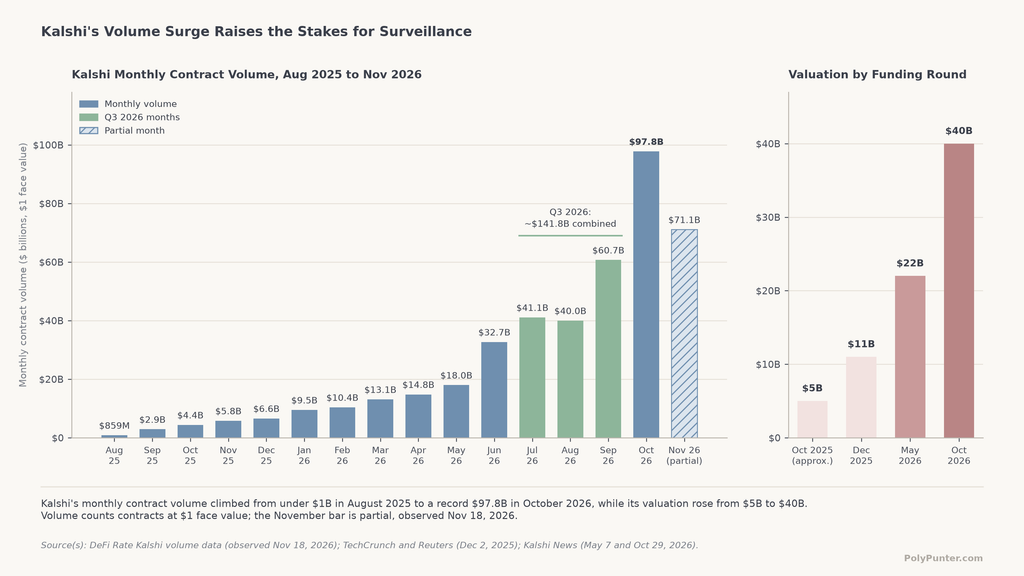
Of course, the tiers sit on top of earlier moves. Kalshi started asking traders in higher-risk markets for employment details in June, and in August it began phasing in Nasdaq’s market surveillance technology. DeNault, whose team has doubled in a year, told the Times it’ll “probably continue to scale up.” Kalshi clearly sees its reputation in market integrity as critical to its future success.
Martha Stewart Brings the Message to Prime Time
Kalshi rolled out a big celebrity ad campaign featuring Martha Stewart, emphasizing its focus on market integrity and “no insider trading.” Stewart, on a set mimicking her 1990s cooking show, is making a pecan pie when the camera finds a spice shaker marked “confidential information.” Her verdict: “We won’t be using that ingredient.” Then comes the kicker: “If you have information that hasn’t been made public, you don’t trade. Simple.”
Kalshi knows how this Martha Stewart casting reads, as she spent several months in federal prison related to SEC violations. That ingredient alone led to strong earned and viral media coverage for the ad rollout. For her part, Stewart pushed the spot from her own account, posting on X that “the best markets don’t have secret ingredients.”
The partnership began with a hat. Co-founder Luana Lopes Lara wrote in a post on X that she met Stewart at the World Cup, where Stewart handed over her own hat while Lopes Lara wilted in the sun. Make of that story what you will. Her sign-off was blunter than any compliance memo: “Listen to Martha, don’t be stupid and don’t insider trade!”
Clearly, the campaign isn’t meant to stop insider traders. It’s a public announcement of Kalshi’s hoped-for brand recognition as an exchange committed to cracking down on cheating in its markets.
Why Kalshi Paused Its Trump Mention Markets
Four days before the ad dropped, the CFTC paused a Trump mention market. A November 13 order stayed the certification behind Kalshi’s TRUMPSAY contracts, plus a market on whether Trump will use nicknames before 2027. Kalshi now has until December 11 to show that its February 2025 self-certification for these markets wasn’t false.
CFTC spokesperson Brooke Nethercott told CNBC the contracts were stayed “because they may be susceptible to manipulation.” Kalshi says it’s complying. It did the same in August, when the regulator asked it to drop sports-related markets. The CFTC-registered prediction markets rely on their CFTC certifications to support their legal defenses in ongoing conflicts with state gaming authorities. They are not well positioned to oppose CFTC requests.
But Kalshi’s CEO isn’t taking it quietly. “We disagree with this decision,” Tarek Mansour told Axios’ Madison Mills at Axios BFD. He argued that “what the president does say moves markets,” and said Kalshi “did catch a few people that did try to move these markets.” Later, he went further, replying on X to a trader’s video tribute with “RIP. I’m sorry we couldn’t save these markets.”
Washington Keeps the Pressure On
Mention markets aren’t Kalshi’s only CFTC headache. On November 10, Politico reported that the agency had privately warned of possibly imminent charges over whether Kalshi properly told regulators about dozens of products in development, a warning Kalshi spokesperson Elisabeth Diana described as “a procedural error involving the submission of a handful of contracts, many of which weren’t live.”
Lawmakers keep circling. Sen. Merkley’s office says he and Sen. Elizabeth Warren asked White House counsel Will Scharf what stops staffers from trading on nonpublic information, with answers due November 23. Earlier, Warren teamed up with Republican Sen. John Curtis to warn Kalshi and Polymarket that a candidate betting on his own race “undermines the overall integrity of the American electoral process.” A newly incoming Democratic-led Congress is certain to be even more active in putting controls on prediction markets across the board.
References
- Kalshi News: Kalshi Adopts Independent Market Integrity Committee’s Q3 Recommendations; Partners with Martha Stewart on Insider Trading Awareness Campaign
- The Lines: Kalshi Strengthens Insider Trading Safeguards, Pauses Trump Mention Markets
- Finance Magnates: Kalshi Flags 50+ Insider Trading Cases as Surveillance Closes In on Leaked Events
- The Seattle Times (The New York Times): Kalshi’s Warning Against Insider Trading, Courtesy of Martha Stewart
- Unchained via Yahoo Finance: CFTC Halts Kalshi’s Trump Mention Markets, Gives the Exchange Until Dec. 11 to Defend Them
- CNBC: Kalshi Takes Down Controversial Trump Mention Markets at CFTC’s Request
- Axios: Kalshi CEO Tarek Mansour Opposes CFTC Decision to Suspend Mention Markets
- Politico: Wall Street Regulator Poised to Bring Charges Against Prediction Market Giant Kalshi
- Office of Sen. Jeff Merkley: Warren, Merkley Press White House for Answers on Insider Trading Scandal Involving Trump Teleprompter Aide