Published: November 13, 2026
Kalshi’s single-stock perpetual futures have already moved $1.75B since they went live on November 5. Most trades sit around $200, and the heaviest action has landed on Nvidia, SpaceX, and Micron. Traders are treating the contracts as a straightforward way to get leveraged exposure to single names without buying the actual shares.
The first morning alone produced more than $300 million in volume. Kalshi co-founder and COO Luana Lopes Lara flagged the early surge in a post on X. Activity has kept climbing as more people have opened positions.
How The Contracts Work And Why Volume Grew Fast
Each contract covers 0.02 shares of the underlying stock, so 50 contracts give you the price move of one full share. There’s no expiration, which means you don’t have to keep rolling the position the way you do with standard futures. Leverage usually stays below 5x and shifts by ticker, while daily funding payments at 4:00 PM ET pull the contract price back in line with the stock.
Kalshi opened more than fifty NYSE and Nasdaq names under joint CFTC and SEC oversight. That made these the first regulated single-stock perpetual futures available to US traders. You can go long or short without dealing with brokerage margin loans, stock borrow fees, or the extra layers that come with options. Kalshi simply charges a clear trading fee instead of routing through payment for order flow.
The opening $300 million showed that traders were ready for a domestic version of a product that has already been popular offshore. Kalshi says global single-stock perpetual volume already tops $4.5 trillion a year. Putting a regulated version onshore gave people a cleaner way to take the same kind of positions under U.S. rules. However, legal wrangling will continue, with the outcome still unclear.
You can watch the live numbers on the Kalshi perps page. As more traders tested the contracts in the days after launch, total volume reached $ 1.75 B. The small size and simple long-or-short setup appear to have helped the early uptake.
Why Nvidia, SpaceX, and Micron Lead Trading
Nvidia, SpaceX, and Micron have stayed near the top of the volume rankings. Nvidia pulls in people tracking AI and data-center moves, SpaceX lets traders take a view on the company’s valuation, and Micron draws interest tied to memory-chip cycles. The three names keep showing up together in the busiest contracts.
Recent 24-hour figures on the platform usually place them high on the stock list. Some of the flow looks like short-term directional trades, while other positions stay open longer as traders follow sector swings. Because the contracts only trade during equity market hours, most volume still comes during regular US sessions when those stocks are moving.
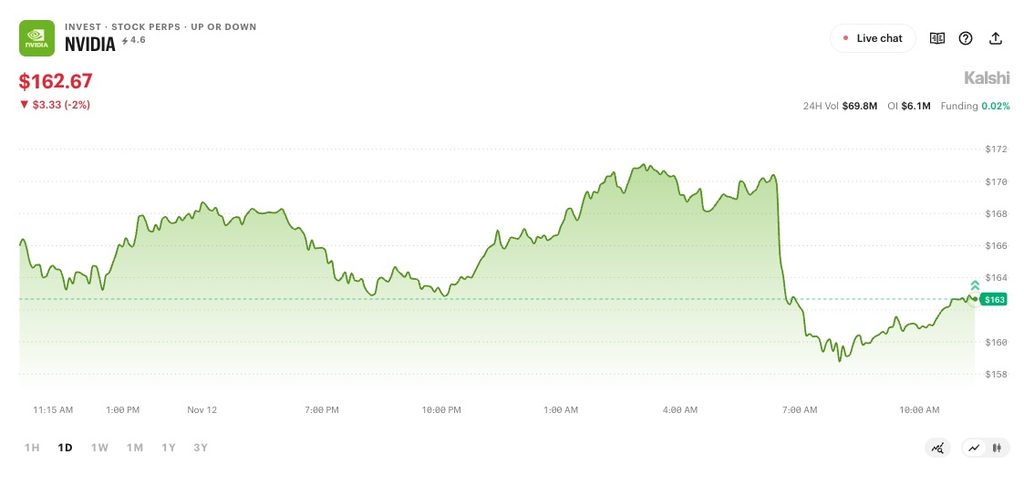
Traders can check real-time volume, funding rates, and available leverage for each name right on the platform. That visibility makes it easier to size a position and pick an entry on the more active contracts. Leverage still cuts both ways, so a sharp move in Nvidia or Micron can amplify losses just as quickly as gains.
The heavy concentration in these three also shows how people are using the contracts for focused single-stock views rather than broad index exposure. Other names are seeing activity too, but Nvidia, SpaceX, and Micron have accounted for a large share of stock-contract volume so far. Their steady interest has helped push the overall total to $1.75B.
What The Typical $200 Trade Size Reveals
The roughly $200 average trade size lines up with the contract design. On a stock trading near $200, fifty contracts deliver about $200 of notional exposure. With leverage, you can open that exposure by posting only a fraction of the amount as margin.
It lowers the bar for individual traders who want stock-like moves without buying full shares through a regular brokerage. A couple hundred dollars of margin can control $200 or more of exposure on Nvidia or Micron. Everything settles in cash, and the positions don’t come with voting rights or any other shareholder benefits.
Take a basic example. A trader posts $50 of margin at 4x leverage on a $200 stock and ends up with $200 of exposure. A 10% rise in the stock produces a $20 gain, which works out to a 40% return on the margin. A 10% drop produces a $20 loss, or 40% of the posted margin. Kalshi’s help center walks through the mechanics and the risk that positions close automatically if margin gets too low.
The $200 typical size points to many individual traders rather than only large institutional flow. Because each contract is just 0.02 shares, people can also add or reduce size in smaller steps. Daily funding and the two settlement windows at noon and 4:00 PM ET make the position management more flexible for everyday users.
What The Volume Means For U.S. Traders
The $1.75B total shows that U.S. traders are putting real money into contracts for directional exposure, with fewer moving parts than traditional stock or futures routes. Shorting doesn’t require a locate or borrow, and the lack of expiration removes the need to manage rolls. The regulated status under CFTC and SEC rules gives people a domestic option instead of the large offshore market for these products.
Volume growth suggests the contracts filled a practical gap for many traders. A closer look at the early order-book behavior appears in this YouTube video on Kalshi’s single-stock perpetuals. The clip walks through the first days of trading and how the contracts actually behaved once volume started flowing.
The risks are still real. Leverage magnifies losses the same way it magnifies gains, and open positions can pick up funding costs depending on the market. Traders have to watch margin levels closely. At the same time, the small contract sizes, visible fees, and US oversight have continued to support activity across Nvidia, SpaceX, Micron, and the rest of the list.
Volumes will keep shifting with market conditions and as more people get comfortable with the products. For the stretch since the November 5 launch, though, the $1.75B figure, the $200 typical trade size, and the clear lead from those three stocks mark a concrete early result for the new contracts. Legal clearances dependent, expect this market sector to only continue to grow.
References
- Kalshi brings single stock perpetual futures to the U.S.
- Kalshi Users Pour $300 Million Into Stock Perps Within Hours of U.S. Debut
- Luana Lopes Lara post on X announcing early volume
- Single Stock Perpetual Futures on Kalshi Help Center
- Kalshi Perpetual Futures trading page
- Kalshi Built a Stock Market in Two Weeks YouTube video
- Kalshi launches single-stock perps, logging over $300 million in early trading
- Kalshi launches first CFTC-regulated single-stock perpetual futures in the US