
Soccer doesn’t care about your feelings. It’s the world’s most popular sport, whether you love it or not. Americans are certainly mixed on their passion for soccer. It’s not a top audience sport domestically, never really having caught on compared to football, baseball, basketball, and hockey. But we live in a global marketplace, and that marketplace is super nuts about soccer. And the World Cup every four years drives that point home.
As the 2026 FIFA World Cup captivates audiences worldwide, investment firm Bernstein has issued a striking forecast. The firm projects up to $10 billion in trading volume across prediction markets throughout the tournament.
Traders have already committed billions to contracts built around the expanded 48-team format, which offers roughly 60% more events than previous World Cup editions. With 104 matches spread over several weeks, liquidity remains consistently high while probabilities adjust in real time, before, during, and after matches. Money is flowing.
Why the 2026 World Cup Stands Out as a Volume Powerhouse
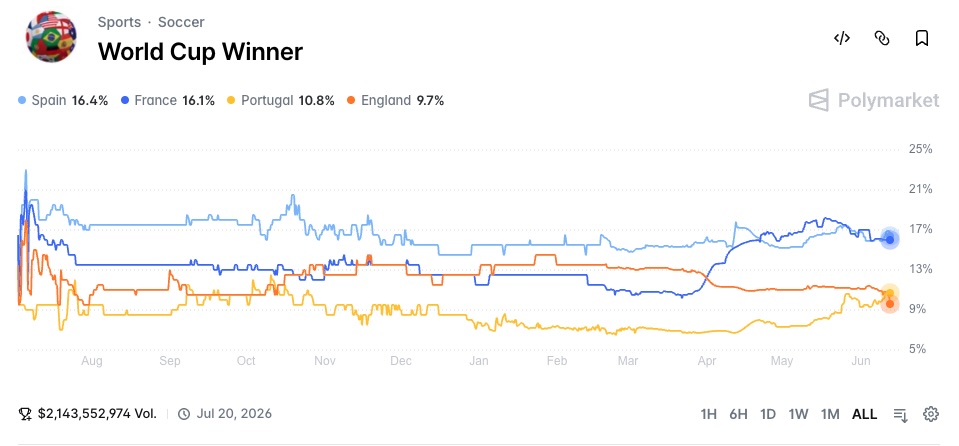
The tournament’s scale, in terms of both matches and global interest, creates unmatched conditions for prediction market trading. As real-time developments unfold on the pitch, volumes on major platforms have climbed sharply. And the tournament is only 24 hours old. It carries on for nearly a month.
Early activity centers on winner markets and individual fixtures, with traders adjusting positions as favorites and underdogs reveal their form in high-stakes tournament competition. The global reach deepens liquidity, giving everyone from casual followers to serious market strategists better execution and tighter spreads.
Breakdown of Projected World Cup Trading Volumes
| Category | Projected Volume | Key Drivers |
|---|---|---|
| Overall Prediction Market Consumer Volume | $5 billion – $10 billion | Expanded 48-team format, 104 matches |
| Incremental Sports Betting Handle | Over $3 billion | Match outcomes, group stages, knockout rounds |
| Platform-Specific (e.g., Kalshi & Polymarket) | A significant share of the total | Real-time contracts on winners and props |
| Pre-Tournament Winner Markets | Nearly $2 billion already | Early positioning on top contenders |
Platforms Leading the Charge in World Cup Trading Activity
Kalshi and Polymarket serve as the primary venues for World Cup event outcome market trading, with Polymarket clearly the leader in volume. Activity intensified immediately after the opening games, with prices moving quickly on fresh field information and Group Stage standings.
While Kalshi emphasizes regulated access, Polymarket attracts users with combo-parlay features that multiply returns on correlated outcomes. As a rule, we at PolyPunter definitely do not promote parlays as a trading (or betting) strategy. Interconnected markets and hedging are quite a different matter, though.
Watch this overview of navigating World Cup contracts effectively:
Broader Industry Implications and Growth Trajectory
Bernstein calls the World Cup a watershed moment that accelerates mainstream adoption of prediction markets for retail users. The event turns a traditionally quiet period for sports-related trading (the time after the NBA Finals and before the NFL season) into a high-volume frenzy, confirming prediction markets as a legitimate financial vertical. Sports contracts now dominate daily activity, merging athletic drama with sophisticated risk management.
Recall that at least one major bank stock analyst issued a warning that he sees prediction markets becoming preferred platforms over sports betting apps as consumers toggle between both.
Institutional desks and improved routing tools have enhanced execution on Kalshi and Polymarket for larger positions. As newcomers gain familiarity, platforms roll out simpler interfaces and advanced data integrations to encourage continued engagement before, during, and after matches.
Polymarket’s combo features let strategic traders layer views across multiple games. As liquidity grows, spreads narrow, improving conditions for both occasional users and professional traders. These developments set the stage for expansion well beyond the tournament. Expect this platform bump to be permanent.
Looking Ahead: Sustaining Momentum Beyond the Tournament
Bernstein maintains an optimistic long-term view, projecting that prediction market volumes could reach hundreds of billions annually by the end of the decade. The World Cup is a high-visibility proving ground, showcasing scalability and appeasing widespread trading interest during peak global activity. User habits formed during these World Cup weeks will likely carry forward into year-round event trading.
References
- Bernstein Forecasts $10 Billion Of World Cup Betting On Prediction Markets
- Bernstein forecasts $10 billion in World Cup betting on prediction markets
- World Cup Could Bring Billions in Volume to Prediction Markets
- World Cup Could Bring Billions in Volume to Prediction Markets
- Prediction Markets Eye $10B World Cup Volume Surge
- Bernstein: 2026 FIFA World Cup Is A ‘Watershed Moment’
- Kalshi Men’s World Cup Winner Market
- Polymarket 2026 FIFA World Cup Markets
- 2026 World Cup Odds Tracker on Kalshi & Polymarket
- Kalshi World Cup Prediction Markets Explained (YouTube)
- Kalshi vs Polymarket World Cup Odds Comparison