The power of prediction markets to forecast election outcomes is growing in popular lore. At PolyPunter, we’ve written multiple times about the accuracy compared to traditional polling, with Polymarket becoming viral in 2024 for accurately prediction the Trump victory over Harris while almost every standard poll had it titled toward Harris. The record is far from 100%. Current elections in California are proving that; though California elections are an outlier for multiple reasons prediction analytics likely can’t calculate. But they have become a go-to tool for election forecasting and prediction both for interested voters, media outlets, and political strategists.
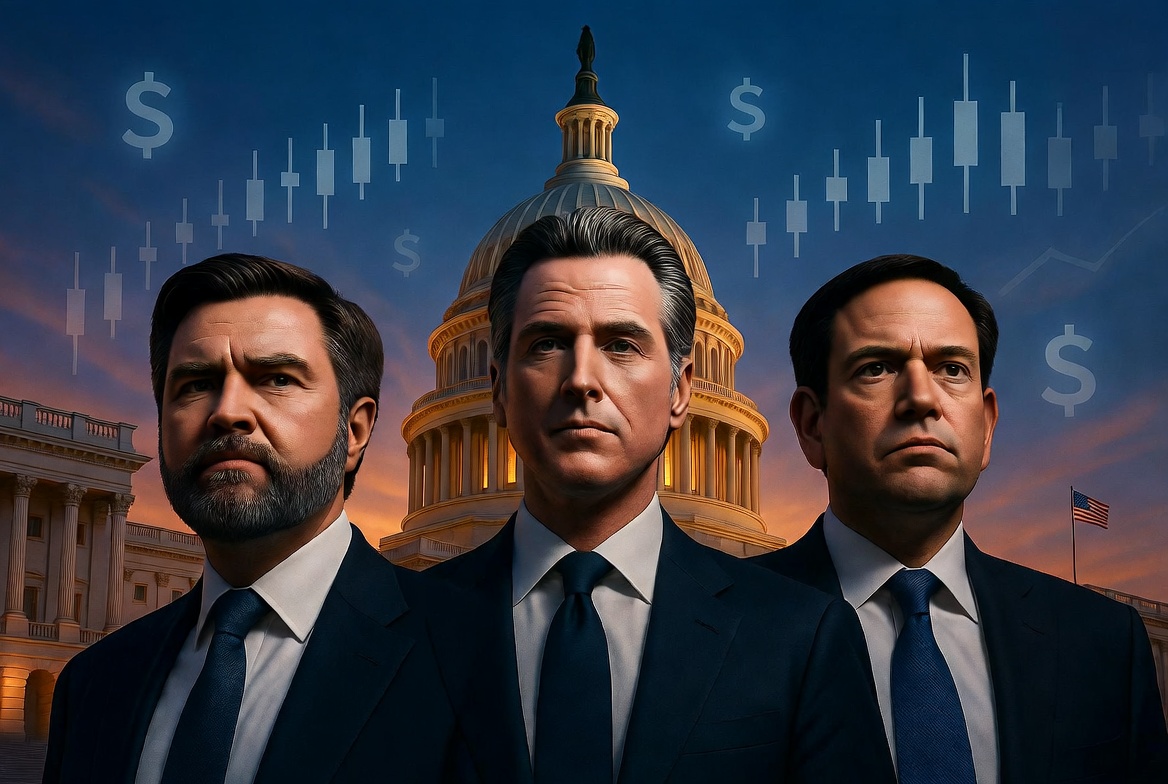
Prediction market traders have already poured over $650 million into 2028 presidential winner contracts, with probabilities shifting nearly daily on frontrunners like JD Vance, Gavin Newsom, and Marco Rubio. While election voting remains two years away, these markets buzz with big money and a now trusted foresight that reshapes how voters, donors, and strategists view the race. The invisible hand of crowd-sourced money now steers narratives long before fields of candidates or any primaries are even set.
This early staked-forecasting excites those who value efficient information, any time, any way, but alarms others who see self-reinforcing loops forming. As market prices rise or fall on whispers and headlines, they influence endorsements, fundraising, and media coverage in turn. Voters won’t resolve the event outcome until November 2028. Meanwhile, it’s June 2026 and key campaign and election decisions are already being made off of forecasts for that date.
Explosive Early Volume Signals a New Era of Pre-Election Influence
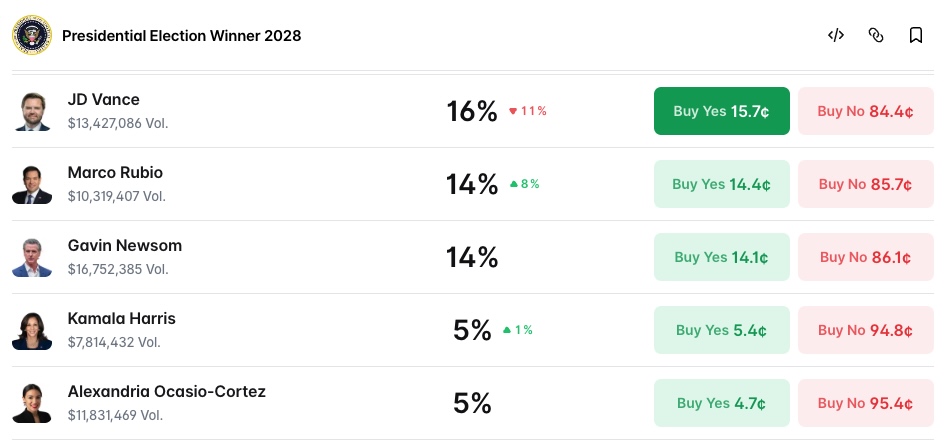
Since mid-2025, Polymarket’s 2028 Presidential Election Winner market alone has generated more than $617 million in trading volume. Polymarket is the known preferred market for election forecasting, though Kalshi is growing and shows tens of millions more flowing into their candidate-specific contracts. It’s not quite World Cup betting levels (now over $1.6 billion a week before the tournament) but the Presidential Election market is significant.
Currently, probabilities hover tightly this early: JD Vance around 16-17%, Gavin Newsom near 15%, and Marco Rubio climbing toward 18% on some platforms. Obviously, these numbers reflect a candidate both winning their primary and the general election; there will be only representative from each party in the general so odds will shift heavily against post-primaries. Lesser-expected candidate names trade at single digits, yet their contracts still draw millions in volume.
And this far out, so much can change. As of this date, none of these candidate have even filed officially to run for President in 2028.
Such high market volumes this early create razor-sharp campaign incentives. A candidate surging a few points attracts donors seeking winners, while fading odds could dry up support. Consequently, campaigns now monitor these platforms obsessively, adjusting strategies to game the probabilities that reporters then broadcast as gospel.
Current 2028 Frontrunner Odds Snapshot
| Candidate | Approximate Probability | Recent Volume Trend |
|---|---|---|
| Marco Rubio | 14-18% | Rising on Kalshi |
| JD Vance | 16-17% | Stable leader on Polymarket |
| Gavin Newsom | 14-15% | Tight contest with top Republicans |
| Others (e.g., AOC, Harris) | Under 10% | High volume on longshots |
This table captures a very fluid probabilities picture as of early June 2026. Probabilities reflect aggregated trader sentiment across major platforms and will continue evolving rapidly.
How Markets Create Momentum That Becomes Reality
Prediction markets excel at aggregating dispersed knowledge because traders stake their own money not on who they want to win, but who they think will win. This is very different from polling where people are asked their personal preference on candidates and who they are likely to vote for come election day.
When a candidate like Rubio gains traction through a strong interview overseas, Senate hearing performances or policy rollouts, traders pile in, pushing prices higher, with the belief that the voting public will see him more “Presidential”. Or to be more specific, primary voters would see Rubio more positively relative to Vance or other GOP primary candidates he would face to become the party’s nominee. Media outlets then highlight those rising odds, signaling viability to undecided voters and hesitant donors.
A surge in market probability boosts a candidate’s perceived electability, encouraging endorsements, invites to various political fundraising organizations to speak, and media interviews that further solidify support. Conversely, sliding prices could starve a campaign of oxygen, creating self-fulfilling declines. Traders, sensing these dynamics, act preemptively, amplifying swings in a particularly closed feedback loop.
In 2028, with markets now live and highly active for years before voting, this effect intensifies dramatically across the extended campaign lifecycles. Strategists are already crafting messaging tailored to move probabilities rather than purely sway voters, knowing that favorable coverage encourages favorable prices which encourages more favorable coverage.
The Media’s Role in Amplifying Market Signals
Newsrooms increasingly treat market prices as authoritative forecasts, embedding them in headlines and graphics. Many media outlets now have formal partnerships with the leading prediction market platforms for election-related forecasting. When Vance or Newsom ticks up a point, news segments frame it as shifting momentum, even absent any additional evidence of a momentum shift.
While you certainly see betting lines discussed in sports commentary, you never see analysts incorporating actual betting movements into their technical breakdowns of gameplay and who will win games.
This feedback loop turns traders’ collective bets into narrative drivers that shape public perception. A viral clip showing a candidate’s Yes contract jumping 5% prompts social media frenzy, drawing more traders and reinforcing the move and further enhancing the media narrative on the rise. Nothing material has happened. But the media story is changing.
While some celebrate this transparency, others worry it sidelines grassroots voices and outsider candidates. Wealthier or better-informed traders exert outsized influence on prices that then cascade into broader discourse that reinforces the early favorites.
This video from a political analysis channel breaks down how recent polling headlines barely budged market odds, illustrating the disconnect and reinforcing how power traders hold the keys.
Strategic Campaign Shifts Driven by Real-Time Pricing
Candidates and their teams now incorporate market data into daily briefings. A dip in probabilities after a gaffe triggers rapid response ads or pivots, while surges unlock easier fundraising pitches to key donors. This data-driven approach rewards response-agility but risks over-optimizing for short-term trader sentiment over long-term strategy. Of course, the response from strategists would be: there is no long term if we don’t survive the short term.
Party insiders watch nominee markets closely. On the Democratic side, Newsom holds a lead in many contracts; Republicans see Vance and Rubio battling. Early positioning in these markets influences who secures key speaking slots, donor meetings, and super PAC backing well before primaries heat up.
Moreover, foreign policy signals or economic announcements now carry double weight, as traders parse them for 2028 candidate implications. Campaigns, aware of this, time announcements to maximize favorable price movements.
If you think this isn’t a major development in campaign strategies, think about how the advent of televised campaign appearances and debates overhauled politics. Quite famously, the Kennedy-Nixon first televised debate in 1960 where viewers felt Kennedy looked youthful and handsome and Nixon nervous and, well, not so handsome, is believed to have shifted votes heavily in that election. Suddenly, campaigns thereafter had significant TV-related strategies and preparations. The same is now happening with prediction markets. The change is seismic.
Risks of Manipulation and Self-Fulfilling Prophecies
High volumes invite attempts to move markets through coordinated buying or strategic leaks. A well-timed large trade can spark media coverage that validates the artificial shift, creating genuine momentum. Regulators and platforms actively monitor for such manipulative activity, yet the decentralized nature of some venues complicates enforcement in real-time or on a timeline that would prove effective in countering immediate results.
Historical examples from earlier elections show how prices can anchor perceptions. When markets favor one outcome heavily, voters and donors may bandwagon, making the prediction come true regardless of underlying fundamentals. In 2028’s prolonged timeline, these loops could dominate for months or years, creating consequences that fundamentally effect election outcomes.
Critics argue this distorts democracy by prioritizing those with capital and information edges. Supporters counter that skin-in-the-game pricing still outperforms traditional polling, with poll results having been used in political media coverage for generations now, so why not use the more accurate numbers?
Party-Level Probabilities and Broader Implications
Beyond individual candidate impact, party winner markets show Democrats with around 55-62% implied odds in various snapshots, reflecting trader views on post-incumbent dynamics. These broader contracts influence down-ballot planning and issue advocacy, as groups align resources with probable White House control regardless of the winning candidate.
These party market traders factor in economic conditions, scandals, or global events embed sophisticated forecasts into prices. Consequently, markets serve as early-warning systems that savvy partisan operatives can exploit.
This short discussion highlights concerns about markets potentially undermining traditional campaign processes.
Why Prediction Market Forecasting Matters for American Democracy
Prediction markets themselves democratize forecasting by letting informed traders profit from accuracy, yet they risk concentrating power among those who can afford to play at larger volumes. All traders have equal access, not all traders are equal. As 2028 U.S. Presidential odds evolve daily, they create a parallel primary system where trader money talks loudest and earliest. Passionate defenders see enhanced accountability; skeptics fear reduced voter agency. Because of the relative newness of this phenomena, it’s fair to say, neither side can prove their case.
As always, and since forever, voters should engage critically with all market-driven narratives and the media that amplifies them. Easier said than done in a low information voter environment where media and social media especially dispenses “news” in a machine gun fashion. While prediction markets won’t literally cast votes, their sway over the pre-vote landscape grows undeniable and transformative.
The 2028 race is the first to truly operate in this new reality. Traders shaping probabilities today will help decide frontrunners tomorrow, long before any citizen even consider who they’re voting for.
References
- Polymarket 2028 Presidential Winner Market
- Kalshi 2028 Election Winner Market
- DefiRate 2028 Odds Aggregation
- When Predictions Become News – Andy Hall
- OregonLive on 2028 Markets
- Election Betting Odds
- YouTube: Stu on AOC Poll and Markets
- YouTube: Big Problem with 2028 Markets