Polymarket traders watched markets worth millions hang in the balance as UMA token holders cast anonymous votes to settle heated disputes. (What is a UMA token?)
This decentralized voting process, which relies on staked tokens for decision-making power, now stands at the center of growing concern because participants can hold positions that directly benefit from specific outcomes. Very common-sense questions are swirling about whether financial incentives distort impartial judgments.
How UMA Token Holder Votes Settle Polymarket Disputes
Polymarket trader disputes work their way through a structured challenge system that culminates in participation by UMA token holders. Anyone can stake $750 to propose an outcome during the initial resolution window. Challengers can match that bond to trigger further review. When two rounds of proposals and disputes occur, the process shifts to UMA’s Data Verification Mechanism, in which token holders stake their UMA and vote over a 48-hour period, split into commit and reveal phases. Voters who come to align with the majority earn rewards, while those in the minority face slashing penalties that reduce their staked holdings.
This incentive structure aims to drive consensus among voters, but it creates opportunities for large holders to exert outsized influence. Transitioning from the community debate in UMA Discord channels to on-chain voting adds layers of transparency, though preserving voter anonymity fuels persistent concerns. Polymarket honors these UMA decisions as binding, even when they diverge from the platform’s initial clarifications on the dispute.
Recent Contentious Resolutions Highlight Voting Power Concentration
In March 2025, the Ukrainian mineral deal market on Polymarket exploded into controversy after amassing over $7 million in trading volume.
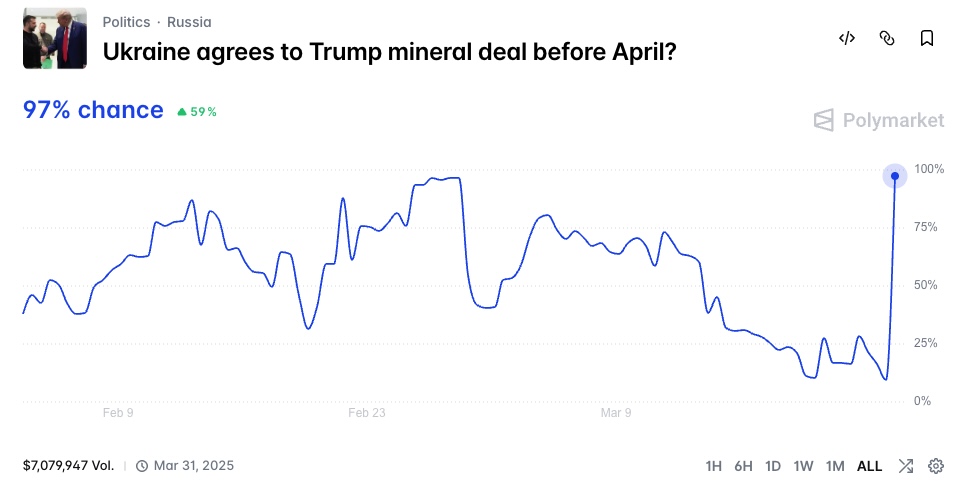
UMA token holders ultimately resolved the contract as “Yes” despite no signed agreement existing at the time, prompting widespread accusations of market resolution manipulation. One wallet, BornTooLate.Eth acquired roughly 1.3 million UMA tokens to rank among the top stakers and cast votes that swayed the outcome, according to on-chain data reviewed by multiple outlets.
Polymarket voters just verifiably got scammed after the UMA Oracle went rogue.
by u/GabeSter in CryptoCurrency
Polymarket acknowledged that the resolution felt unfair and unexpected to many bettors but declined to issue refunds, citing the integrity of its established dispute process. Meanwhile, community members on Reddit detailed how the vote contradicted Polymarket’s own clarification, urging a “No” result. This episode underscores how concentrated voting power among a handful of whales can override broader expectations of the dispute resolution participants.
Major Disputed Polymarket Markets Resolved by UMA Votes
| Market Topic | Trading Volume | UMA Resolution | Key Controversy |
|---|---|---|---|
| Ukraine Trump Mineral Deal (March 2025) | $7 million+ | Yes | Whale vote overrode platform clarification; no deal signed |
| Zelenskyy Wears Suit by June 2025 | $59 million+ | No | Debate over jacket interpretation sparked governance backlash |
| Trump Administration UFO Files Declassification (2025) | $16 million | Yes | Late-session buying preceded UMA vote despite no releases |
Although most resolutions proceed smoothly, the outliers capture attention and erode trust among smaller participants who feel sidelined by whale dominance, even within market resolution processes.
Financial Incentives Raise Alarms in Anonymous Voting Process
RememberAmalek noted that voters staking millions of UMA tokens often prioritize majority alignment to avoid slashing rather than strict factual adherence, in a Yahoo Finance interview.
Recent data shared by crypto analyst Nick Devor reveals that 72% of votes deciding Polymarket’s most disputed market resolutions involve participants with identifiable conflicts of interest. If you’re concerned that’s a rather large number, you ought to be.
Such statistics emerge from on-chain tracking that links wallets across platforms, although full anonymity complicates complete verification.
Barron’s reporting and UMA co-founder Hart Lambur have rejected claims of manipulation in past disputes, emphasizing the protocol’s economic safeguards. Still, the system’s design inherently rewards consensus participation, which traders argue can favor expediency over accuracy.
This dynamic persists even as disputed market volume on Polymarket has historically exceeded $972 million.
Community Backlash Grows as Whale Influence Dominates Votes
Traders took to social platforms to voice outrage following the Ukraine resolution, pointing to a single actor controlling 25% of the votes in that round. One detailed X thread by threat researcher Vladimir S. traced the governance attack to multiple accounts holding a combined 5 million UMA tokens.
Similar frustrations surfaced around the Zelenskyy suit market, where interpretations of attire sparked a $59 million showdown. Bettors on the losing side accused the resolution process of favoring subjective rulings that benefited certain holders. UMA’s official X account responded by outlining voting mechanics, yet these explanations have not fully quelled demands for reform.
Prediction markets have an inherent, internal battle between whales and retail-level traders who already feel disadvantaged on the platform. These high-profile instances in which the whales seem to be controlling voting on dispute resolution are likely to exacerbate that conflict and concern.
YouTube Insights Reveal Deeper Layers of the UMA Controversy
Podcasters have dissected these events in detail, offering traders context on the stakes involved. Watch this Unchained episode featuring bettor Calvin Hamilton discussing the Zelenskyy suit market fallout and its implications for UMA and Polymarket.
Another resource explains the core voting process within UMA’s Optimistic Oracle, helping newcomers understand incentive structures at play.
Calls for Reform Intensify Amid Ongoing Resolution Challenges
Polymarket faces mounting pressure to address oracle vulnerabilities exposed by repeated, high-profile disputes. Although Polymarket insists that UMA delivers decentralized truth-seeking, critics point to an elitist dynamic in which two or three large holders can tip the scales. This conflict, even merely in appearance, clashes with the open, permissionless ethos many users expect from crypto-native systems, as detailed in The Defiant’s coverage.
Discussions in the UMA Discord and on-chain forums propose hybrid models or enhanced transparency requirements in UMA token voting. Staked voters earn up to 16% APR through consistent, truthful participation, yet the reward structure itself draws scrutiny for potentially incentivizing herd behavior.
Transitioning toward mechanisms that reduce the influence of a small number of whales could restore confidence
UMA token holders continue arbitrating disputes daily, with over 21,000 proposed outcomes processed in recent months.
Broader Implications for Crypto Dispute Mechanisms
As Polymarket trading volumes surge, the reliance on anonymous UMA votes carries consequences that extend beyond individual markets. Bettors must now factor community voting dynamics into their gaming strategy. This evolution transforms resolution from a background process into a frontline concern that shapes participation.
Polymarket has explored overrides to dispute resolutions in isolated cases, although it rarely exercises that option to preserve protocol neutrality. The system puts Polymarket between a rock and a hard place. Intrude, and you look like you’re putting your hands on the scales. Don’t intrude, or you may have many traders upset with a nonsensical resolution.
References
- Polymarket’s Most Contentious Debates Are Being Decided by Anonymous Crypto Votes – Barron’s
- Polymarket, UMA Communities Lock Horns After $7M Ukraine Bet Resolves – CoinDesk
- Polymarket voters just verifiably got scammed after the UMA Oracle went rogue – Reddit
- ‘This Isn’t Decentralized,’ Says Polymarket Power User – Yahoo Finance
- Resolution Documentation – Polymarket Docs
- Polymarket’s $7M Ukraine Mineral Deal Debacle – The Defiant
- Vladimir S. X post on governance attack – X (formerly Twitter)
- UMA Protocol X post on Polymarket settlements – X (formerly Twitter)
- Unchained Podcast: $59 Million Polymarket Bet Controversy – YouTube
- Voting to resolve disputes in UMA’s Optimistic Oracle – YouTube
- Can LLMs Help Decentralized Dispute Arbitration? – arXiv Paper
- How Are Markets Disputed? – Polymarket Help Center
- UMA Official Site – UMA Protocol