
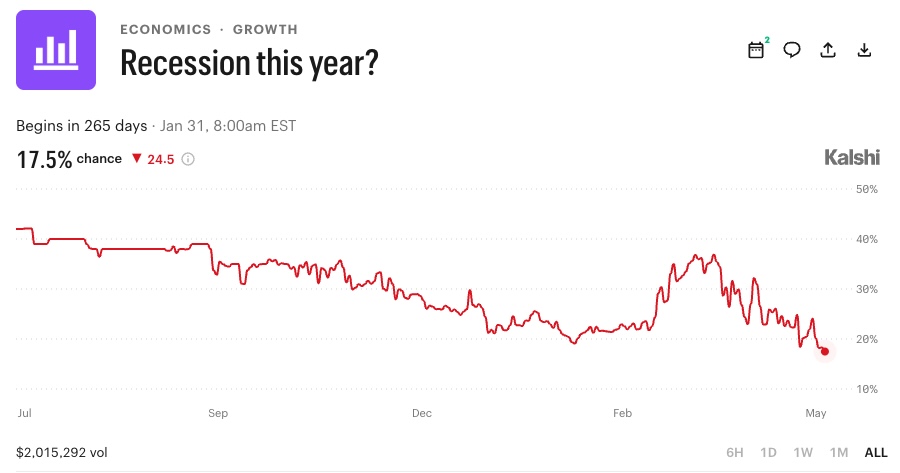
Prediction markets now show low odds of a recession in 2026, with traders pricing the chance of a U.S. economic contraction at record lows near 20%. Kalshi bettors push yes shares on the recession contract down to 20 cents (and declining).
Polymarket participants assign only a 22% probability over the full period.
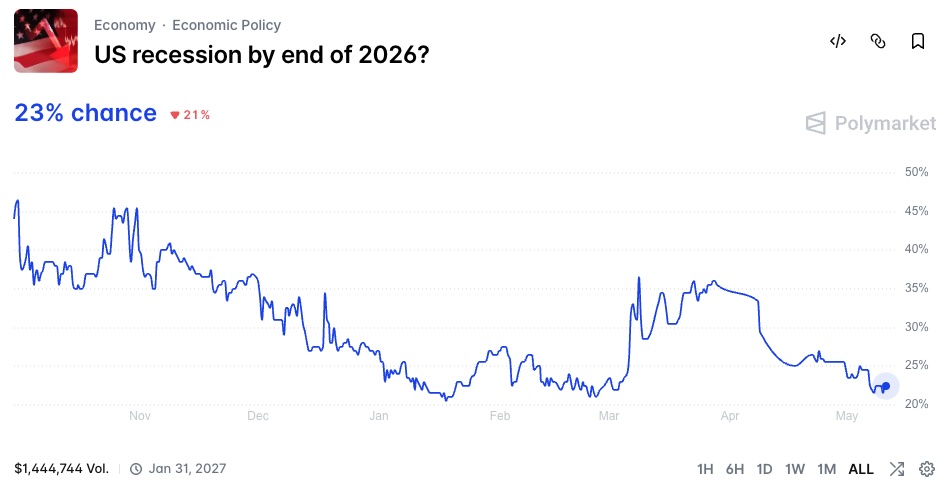
This sharp repricing from earlier 40% peaks highlights strong collective confidence driven by fresh data releases and policy shifts. Low recession probability prediction markets deliver real-time sentiment that often moves faster than traditional economic forecasts. Prediction market recession indicators stand out as dynamic tools that aggregate thousands of informed bets into precise probabilities.
Prediction Market Recession Indicators Flash Record Low Odds for 2026
Kalshi traders drive the 2026 recession contracts to an all-time low of under 20%, with robust volume topping $2 million. Polymarket sees similar action on its end-of-period recession market, with 22% Yes and over $1.4 million committed. Consequently, these platforms reflect broad optimism that the economy avoids two straight quarters of negative GDP growth. Low 2026 recession odds capture this sentiment instantly as participants react to incoming numbers. The sustained drop underscores how bettors weigh positive momentum more heavily than lingering risks.
Current Low Recession Odds 2026 Snapshot Across Platforms
| Platform | Recession Probability | Trading Volume | Recent Movement |
|---|---|---|---|
| Kalshi 2026 GDP Contract | 20% Yes | $2,015,269 | Down from 40% high |
| Polymarket End-of-Period Recession | 22% Yes | $1,443,058 | Near record low |
These low-recession-probability prediction markets transform scattered opinions into tradable consensus. Participants update their positions within hours of data drops, and pricing remains highly responsive. Volume levels remain elevated, which signals genuine conviction rather than temporary hype. Prediction market recession indicators like these increasingly guide investor attention across the economic calendar.
Strong Economic Data Fuels Drop in Recession Odds 2026 Prediction Markets
First-quarter 2026 real GDP grew at a solid 2% annualized pace while April payrolls added 115,000 jobs and unemployment held at 4.3%. March CPI came in at 3.3% year-over-year, yet the New York Fed yield-curve recession probability eased toward 17.6%
FOMC members project continued 2.4% growth, which aligns closely with platform pricing. Consequently, traders bid no shares higher on low-recession-odds 2026 contracts. Prediction market recession indicators absorb these releases immediately, giving them a timeliness edge over slower surveys.
Bettors favoring expansion respond quickly to resilient figures; therefore, the markets reinforce soft-landing narratives in real time. Low-recession probability prediction markets now trade at levels last seen during steady-growth phases.
The rapid repricing creates an action-packed environment where every data point can shift probabilities. This dynamic process turns raw statistics into forward-looking guidance that participants trust.
Policy Tailwinds Strengthen Low Recession Probability Prediction Markets
Deregulation steps and moderating geopolitical pressures contribute to the optimistic tilt visible in current contracts. Traders incorporate these developments directly into positions, which pushes 2026 recession predictions even lower. Kalshi volume spiked during recent releases, showing how policy news converts into committed capital. Polymarket liquidity stays high, prices reflect broad participation, and stay informative. Prediction market recession indicators blend policy expectations with hard data to produce nuanced probabilities.
Participants continue learning because incoming flows support resilience. As a result, the platforms serve as living barometers that evolve daily with events. This real-time adjustment distinguishes them from static economic consensus. The passionate positioning in order books adds credibility to the overall low recession signal.
Prediction Markets vs Traditional Recession Forecasts Comparison
| Source Type | Recession Probability | Time Horizon |
|---|---|---|
| Low Recession Odds Prediction Markets | 20-22% | 2026 Period |
| JPMorgan Economic Team | 40% | Next 12 Months |
| Goldman Sachs Projections | 25% | 2026 Outlook |
| New York Fed Yield Curve | 17.6% | Current Model |
Prediction market recession indicators sit comfortably below several bank forecasts and closely match yield-curve models. 2026 prediction markets, therefore, offer a capital-backed alternative that many decision-makers cross-reference. Differences emerge because traders risk real money, which sharpens their collective judgment. The alignment with certain models boosts confidence in the platforms’ forward-looking power.
This video breaks down a highly accurate recession signal that complements the data supporting today’s low odds on prediction markets.
Remaining Risks and How Prediction Markets Price Them
Oil volatility and sticky 3.3% inflation still attract selective hedging, yet positive data outweigh these concerns for now. Global supply issues could flip sentiment quickly; therefore, participants keep positions flexible on recession odds contracts. Low recession probability prediction markets react instantly to new developments, keeping probabilities honest. Critics highlight debt levels and housing costs, but current pricing still favors expansion. Prediction market recession indicators thus balance optimism with visible pockets of vulnerability.
The markets acknowledge risks without letting them dominate the headline probability. As a result, the signal remains bullish while staying transparent. Daily adjustments produce a nuanced view that evolves with fresh information. This responsiveness makes the platforms valuable for ongoing economic monitoring.
Why Low Recession Odds Matter for Business and Investing Decisions
Executives and portfolio managers consult these probabilities when planning expansions or allocating capital. The Kalshi and Polymarket declines in pricing during a recession translate into practical guidance for hiring and investment timing. Consequently, low-recession-probability prediction markets serve as early-warning tools that flag shifts before official reports. Prediction market recession indicators influence real-world strategies by quantifying crowd wisdom in real dollars. Traders committing to no shares demonstrate confidence that growth continues, a confidence that ripples across markets.
Watch this detailed look at how prediction markets deliver powerful economic forecasts during periods of uncertainty.
Future Outlook for Recession Odds 2026 Prediction Markets
Upcoming CPI prints and FOMC decisions will test current pricing as participants rapidly adjust positions. Strong growth combined with moderating inflation keeps No shares favored, although volatility remains possible. Prediction market recession indicators stand prepared to reflect any meaningful pivot. Bettors’ pricing against downturns signals stability that incoming data increasingly validates.
These platforms convert abstract economic risks into tradable probabilities that move with the news cycle.
References
- Kalshi Recession Contract 2026
- Polymarket Recession by the end of 2026
- Forbes Coverage of Record Low Recession Betting Odds
- Yahoo Finance Kalshi Recession Odds Update
- New York Fed Recession Probability Model
- YouTube: Accurate Recession Indicator Breakdown
- YouTube: Prediction Markets Forecasting Strength