Traders in Fed rate decision markets on Kalshi signal overwhelming confidence that the Federal Open Market Committee will maintain current interest rates at the April 28-29 meeting. Interest rate prediction markets on Polymarket price a 99 percent or higher probability of no change to the federal funds target range of 3.50-3.75 percent. This tight consensus has strengthened rapidly as incoming economic data highlights sticky inflation alongside a resilient labor market.
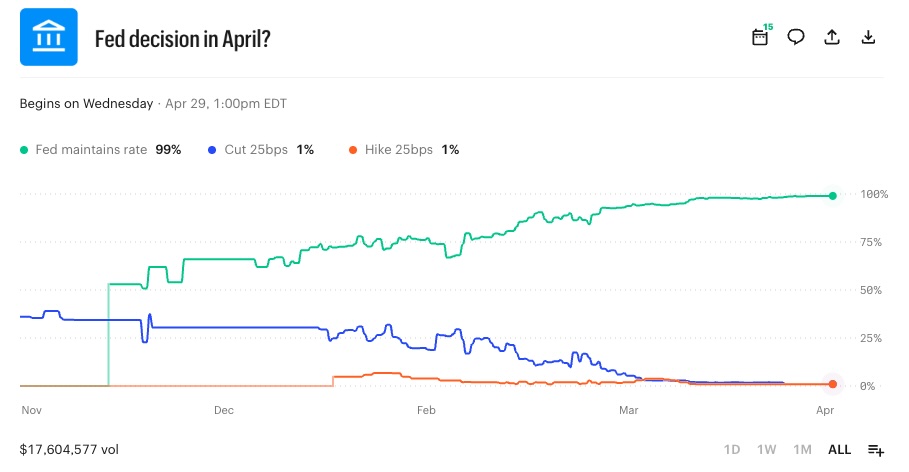
Participants show virtually no expectation of a 25-basis-point cut or hike. Consequently, markets for Fed rate decisions now serve as a real-time gauge of the April outcome amid persistent price pressures. Market pricing leaves almost no room for policy surprises at this session.
Fed Rate Decision Markets Show 99%+ Probability of No Change in April 2026
High-volume contracts on major platforms assign 99.9 percent implied odds to a rate hold following the April FOMC meeting. Traders actively buy and sell outcomes tied to exact basis point shifts, with the no-change contract dominating all activity. Volume has climbed into the hundreds of millions as the meeting draws near.
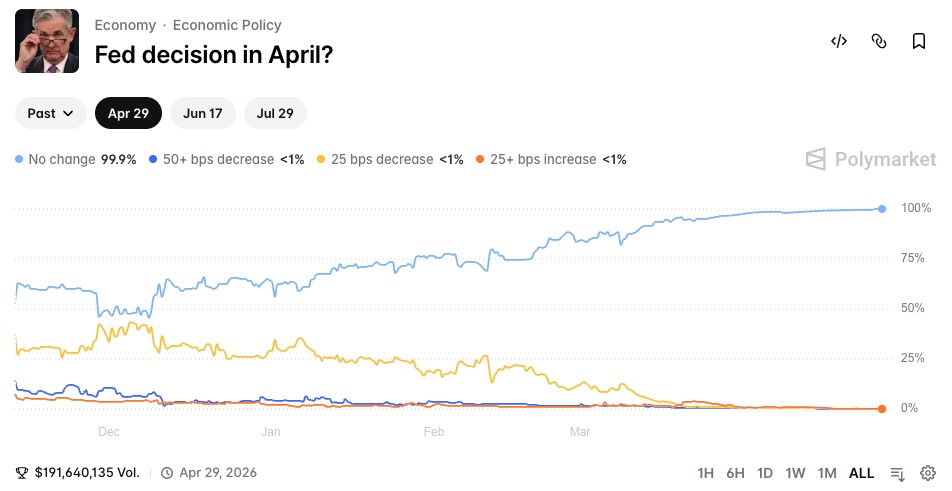
This consensus builds directly on recent data releases. Meanwhile, last-minute surprises appear unlikely given the steady flow of information. Fed rate decision markets therefore reflect broad trader agreement that officials will stand pat.
April 2026 Fed Rate Decision Markets Current Probabilities
| Outcome | Implied Probability |
|---|---|
| Fed maintains rate (no change at 3.50%-3.75%) | 99-99.9% |
| Cut of 25 basis points | <1% |
| Hike of 25 basis points | <1% |
| Larger cut or hike of 50 basis points or more | <1% |
These probabilities capture live trading across platforms. The near-unanimous view holds firm despite external factors influencing certain inflation components.
Watch this discussion on how shifting Fed expectations reshape market positioning ahead of key decisions.
Economic Data Strengthens Consensus in Fed Rate Decision Markets
March consumer price index data rose to 3.3 percent year-over-year. Energy prices surged 10.9 percent in the month, with gasoline jumping over 21 percent. Core measures eased modestly yet still sit above the 2 percent target.
Nonfarm payrolls added 178,000 jobs while the unemployment rate held at 4.3 percent. These figures demonstrate ongoing labor market strength. Therefore, the data provides little basis for immediate easing and reinforces the hold outlook priced into Fed rate decision markets.
Officials reviewed comparable dynamics in prior projections. As a result, interest rate prediction markets have aligned pricing with this environment of balanced risks.
Key Economic Indicators Shaping April 2026 Fed Outlook
| Indicator | Latest Reading | Impact on Fed Rate Decision Markets |
|---|---|---|
| March CPI (YoY) | 3.3% | Sticky inflation supports rate hold |
| Nonfarm Payrolls (March) | +178,000 | Resilient jobs data delays easing |
| Unemployment Rate | 4.3% | Sticky inflation supports a rate hold |
| Energy Index (March) | +10.9% | Geopolitical effects add inflation risk |
Collectively, these readings tighten the probability distribution. Policymakers encounter conditions that discourage premature adjustments.
CME FedWatch Tool Aligns Tightly with Interest Rate Prediction Markets
The CME FedWatch Tool registers approximately 99 percent odds of no change after the April meeting. This futures-derived measure tracks closely with crowd-sourced probabilities on event platforms. Consequently, the alignment boosts confidence among those hedging macro exposures.
Participants noted minimal odds of movement at the following June session as well. Fed rate decision markets incorporate this consistency when building positions. The tool, therefore, acts as an independent validator for current pricing.
CME Group explores the Federal Reserve’s evolving 2026 policy path and modest adjustment possibilities later in the year.
Broader 2026 Rate Path Implications from Fed Rate Decision Markets
Attention shifts quickly toward the full-year outlook, even with April locked. Pricing now assigns roughly 40 percent probability to zero rate cuts across 2026. This marks a meaningful shift from earlier forecasts that anticipated one or more reductions.
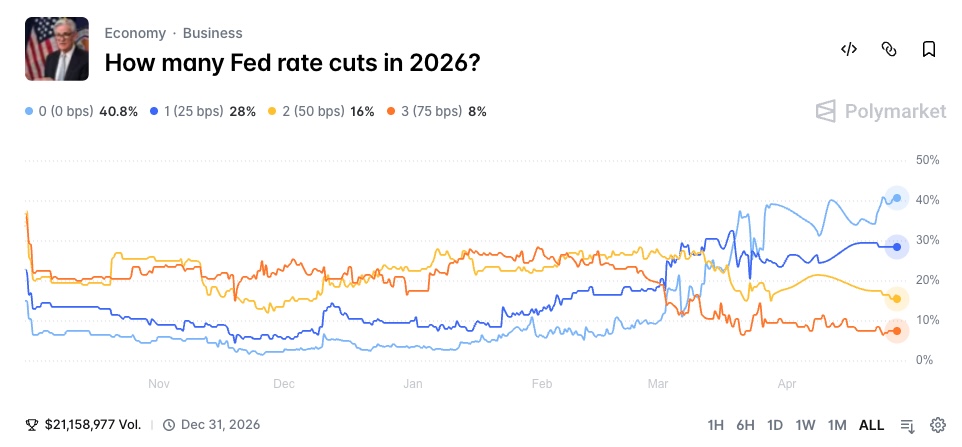
Forecasters at major institutions have adjusted projections accordingly. March FOMC materials highlighted divisions among officials, yet real-time data have pushed sentiment toward a more measured pace. Fed rate decision markets therefore function as a dynamic barometer for longer-horizon expectations.
Options and futures pricing reflect growing dispersion around 2027 outcomes. Participants monitor these signals while fine-tuning strategies tied to subsequent meetings.
Portfolio Strategies Leverage April Hold Consensus in Fed Rate Decision Markets
Managers embed the near-certain April outcome into broader hedging frameworks. Strategies emphasize protection against sustained inflation or stronger growth readings. Traders layer contracts that settle on precise FOMC statement language.
Precise event pricing enables targeted risk management in bonds and equities. Broader year-end rate derivatives add further layers of coverage. This setup promotes proactive positioning rather than passive observation. Consequently, Fed rate decision markets sharpen focus on data dependencies ahead.
References
- Fed decision in April? Odds & Predictions 2026 – Kalshi
- Fed decision in April? Trading Odds & Predictions 2026 – Polymarket
- CME FedWatch Tool
- The Employment Situation – March 2026 – BLS
- How many Fed rate cuts in 2026? Predictions & Odds – Polymarket
- Federal Reserve FOMC Meeting Calendars
- The Interest Rate Narrative Has Flipped – YouTube
- What’s the Fed’s 2026 Playbook? Presented by CME Group – YouTube