Federal Regulator Acts Quickly After Governor Signs First Statewide Felony Prohibition
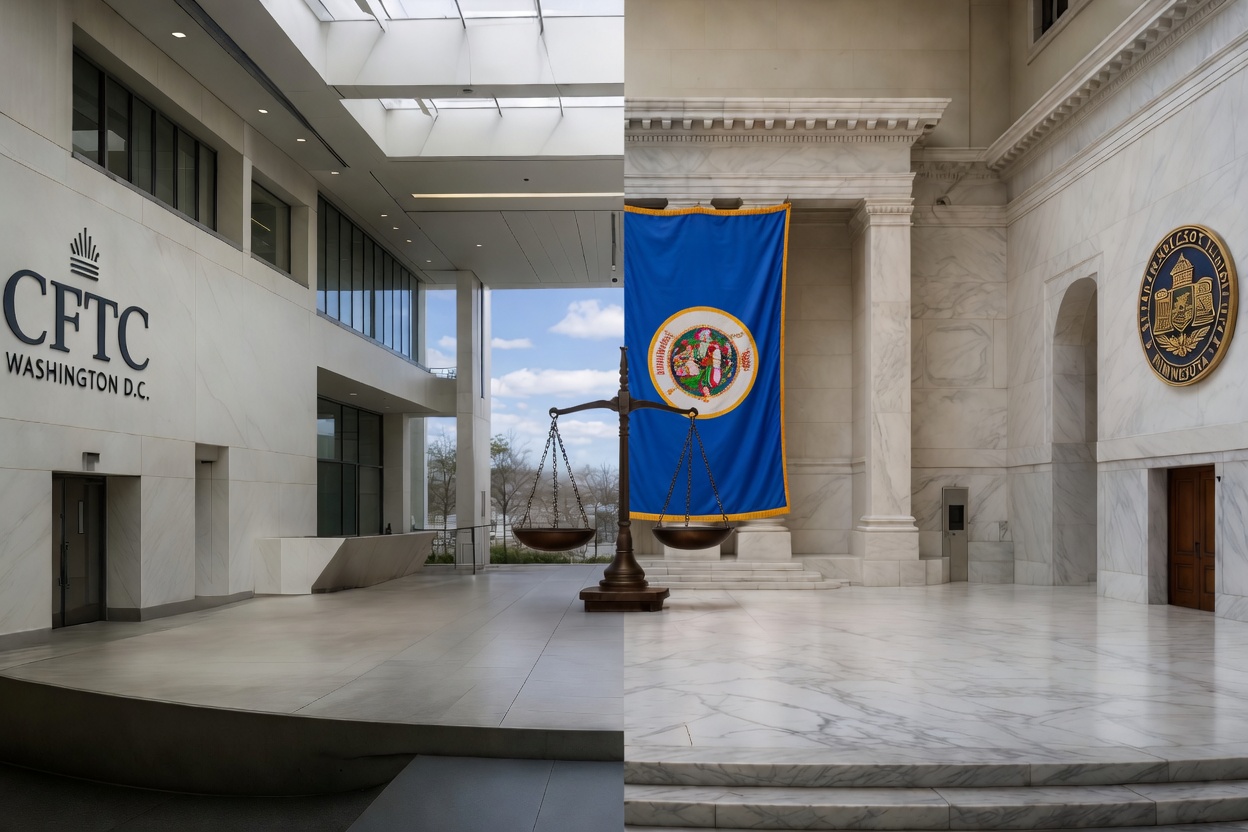
The Commodity Futures Trading Commission (CFTC) is not playing around. The federal agency that claims domain over prediction market regulation filed a federal lawsuit Tuesday against Minnesota officials, directly challenging the first explicit statewide ban on prediction markets that Governor Tim Walz recently signed into law. This “supremacy” move seeks a preliminary injunction blocking the August 1 effective date, as the CFTC asserts federal preemption over states seeking to assert regulatory control over prediction markets.
The Minnesota legislation criminalizes operating, facilitating, or advertising event contracts, extending felony penalties to payment processors and VPN services that enable such activities. Effectively, it’s a full prohibition.
CFTC Chairman Michael S. Selig delivered a pointed rebuke in the agency’s official release:
“This Minnesota law turns lawful operators into felons overnight.”
Subsequently, Selig stressed the harm to Minnesota farmers who rely on weather and crop hedging tools through CFTC-regulated event contracts. He accused state leaders of favoring special interests over agricultural innovators who depend on these established risk-management instruments amid volatility.
Minnesota Legislation Imposes Broad Felony Restrictions on Event Contracts
Minnesota’s measure, which bipartisan legislators tucked into a public safety omnibus bill, broadly defines prohibited activities as systems allowing wagers on outcomes spanning sports, elections, entertainment, weather patterns, and global events.
Lawmakers designed the ban to target prediction market platforms like Kalshi and Polymarket, as well as third-party companies that assist with functions such as payment processing, thereby imposing one of the most expansive restrictions to date. Although the bill carved out narrow exceptions for certain insurance products and traditional securities, make no mistake, this was the ban of all bans on prediction markets.
Bill proponent Rep. Emma Greenman argued that states must retain the authority to address activities they classify as gambling, especially to protect younger residents and uphold public safety. Yet her and her like-minded colleague’s position collides head-on with federal oversight under the Commodity Exchange Act, setting up yet another high-stakes legal test of preemption doctrines in derivatives trading.
Core Elements of Minnesota’s Prediction Market Prohibition
| Aspect | Details |
|---|---|
| Effective Date | August 1, 2026 |
| Penalties | Felony charges covering operation, facilitation, and advertising |
| Covered Activities | Sports, elections, weather, entertainment, and additional event outcomes |
| Liability Reach | Extends to processors, VPN providers, and supporting services |
CFTC Escalates Action Against Now Six States in Rapid Sequence
This complaint represents the sixth federal lawsuit the CFTC has brought against states pursuing similar restrictions on prediction markets in recent months. Courts have issued preliminary relief favoring federal jurisdiction in earlier cases involving Arizona, Connecticut, Illinois, New York, and Wisconsin. In Arizona, where legislators made it a crime for Kalshi to offer prediction market contracts within the state, a judge granted a temporary injunction against prosecution, indicating a favorable trend for the agency’s arguments.
The CFTC suit against Minnesota names Governor Walz, Attorney General Keith Ellison, the Minnesota Department of Public Safety, and gambling enforcement director Jon Anglin as defendants. The legal filing underscores the agency’s resolve to secure relief for prediction markets before the August 1 bill deadline. For his part, CFTC Chairman Selig warned that Minnesota farmers, operating in a key agricultural region, risk losing proven hedging mechanisms if enforcement advances.
Kalshi representatives called the Minnesota ban a direct violation of their federally protected rights, one that stifles competition and will simply drive activity to unregulated venues. Polymarket reps echoed support for the prevailing CEA/CFTC federal framework, which should override inconsistent state-by-state measures. These positions emerge amid climbing trading volumes across diverse event categories.
Watch: Minnesota Senate debates and passes the prediction market ban measure.
Legal Battle Highlights Nationwide Tensions Over Event Contract Authority
Minnesota’s felony-driven prediction market ban stands out for its sheer breadth and consequences. Chairman Selig has pledged to continue defending federal authority against the growing number of state efforts to regulate prediction markets under state gambling laws. Court rulings here could shape interpretations of the Supremacy Clause as applied to financial innovations.
Supporters of the Minnesota ban insist that states have legitimate authority to regulate perceived gambling within their borders, particularly regarding traditional forms of betting, such as sports wagering, and societally sensitive events, such as political outcomes.
Timeline Shows Accelerating State-Federal Clashes
The Minnesota development follows a wave of enforcement actions that intensified this year. Platforms expanded sports and event offerings, prompting several states to issue orders or pursue measures that drew sharp pushback from the CFTC. In each instance, the agency has maintained exclusive jurisdiction, declaring that state gambling statutes cannot lawfully disrupt CFTC-registered contract markets.
Minnesota legislators passed the prohibition with bipartisan backing before delivering it to Walz, who signed it as part of the larger safety package. Subsequently, the CFTC responded with remarkable speed, filing suit shortly after news surfaced. Court documents outline how the law criminalizes federally permitted activities, producing a conflict that demands judicial resolution.
We’re likely not seeing the end of this until it reaches the highest appellate court in the land.
Watch: Minnesota lawmakers examine and advance the ban on prediction markets.
Anticipated Developments in the High-Stakes Dispute
Legal proceedings suggest Minnesota’s measure may face injunction barriers similar to those in prior cases, with its felony elements and broad scope of control over prediction markets inviting heightened review. A CFTC victory would solidify federal preemption and perhaps discourage additional outright bans elsewhere. Though you’d imagine much of this is driven by demands and donations from existing gaming interests in the state.
References
- CFTC Press Release on Minnesota Lawsuit
- MPR News on Minnesota Ban Passage and Lawsuits
- Star Tribune Coverage of Minnesota Ban Details
- CFTC Chairman Selig Statement on State Actions
- Gambling Insider Report on Minnesota Passage
- Minnesota House on Ban Amendment
- Front Office Sports Report on the Lawsuit
- Public Gaming on Minnesota Ban Authority Question